







5/1/08
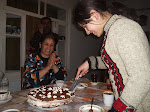
The Engagement Party
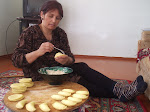
The table is set. Forks and spoons of different sizes and shapes are hurriedly left on the right side of each plate. Thick cups above cheap china wear and shot glasses, 10 minutes before ceremony, clenched in men’s hands. Roasted chicken, dolma, stalichni salad, bosboscht, plov and greens swell under the giant, heat-entrapped tarp. Small boys I haven’t seen in the fit of days preceding, relay Coke and Fanta bottles to each table. Each second, like a quarter of real time, ascends as the clock ticks to.
Will the guests leave happy? Will people dance and eat? Will they tell others that they had a good time, or will it just be a front, a momentary acquisition of kindness because of this special day?
This is like being on the set of The Hours, Azerbaijani time. Gizbast Teacher loiters in my face as panic moves her closer to the engagement party of her first-born daughter.
“Sasha, please help Nisa.”
“With what? Where is she?”
“Sasha, I don’t know.”
The night prior we lugged boiled potatoes, carrots, jarred peas, mayonnaise, steamed beef and onions to Grandpa’s house to cut into retardedly tiny pieces for stalichni salad, a Russian side served at all Azerbaijani events. For nearly 150 people, the dish was prepared in just under four hours. It was a teaser to the day ahead.
Three hours to, I watch the khanams, in the moist, oppressive outside kitchen, slice tomatoes and cucumbers and arrange them diagonally on one of several shades of white plates.
“What’s wrong?” or “What’s up?” or “What are you doing?” asks a curly-haired lady.
“Nothing. Can I help you?” I try, though I think I ask if she can help me.
“Take the chicken. One for each table,” she repeats five times.
“I understand, I understand, I understand.”
I grab three plates of the roasted chicken. Before I swing waitress style around to the dining area, a white-haired old hag with a three golden teeth asks me for tea. I light a match on the burner since my hand will catch on fire if I try the popular pull-away method with a lighter. I balance the porcelain tea pot with the kettle on the circular steel plate.
As I leave the preparation area, the sun shocks my senses. I determine today am a full-fledged member of the party staff, not a World Heritage site as I’m commonly perceived.
The chicken gets distributed so I glide upstairs like Cinderella to locate sugar and candy. There wait stacks of kielbasa to be cut, but no nasty Russian chocolates.
Hoping the khanams have gone the five feet to serve themselves, I flip to the other side of the room to serve a loaded dish.
“Take these greens,” she says without looking up. “Take these greens,” she repeats as my hands jerk the plate from her next cucumber. “I understand.”
“Sasha, why you not wash these?” Nisa asks about the silverware as I set down the first round of veges. Nisa is Gizbast’s niece and an undergraduate of international relations at one Baku’s top universities. She has been learning Arabic, Russian and English and dreams of working as a foreign policy advisor. I like her when she’s not assistant to wedding parties.
“Please help, Sasha.” I give in, clearly having not been of use in past hours.
“You need to tell me which ones to wash.”
“Ok Sasha, wash these.” I wipe four forks before she carts away the wet box of silverware.
“We must have, get drinks.”
Young boys rush out with soft drinks as if Nisa snapped her fingers and wrinkled her nose.
I turn to help when I realize Brent is sitting at a table for five alone.
“Hey Brent, how ya doin’?”
“All right.”
“Are you havin’ an all right time?”
“Yeah, just talking to these guys.” He points to the men sucking down hydrogen peroxide, which passes as vodka in Azerbaijan.
Brent is a lanky Oklahoman who lives 25 minutes south-west of me. He’s a quiet guy and doesn’t travel much. He enjoys the comforts of community and still lives with his host family, eating Azeri meals and speaking the language near-proficiency. Unfortunately this leads Volunteers to ask me more about my boyfriend in America than about my site mate, one of their coworkers and friends. Like so many PCVs do, I have forgotten about him in the frenzy of affairs.
“Hey, I’m going to try to find some juice to put in the fridge.”
“That’s a great idea.”
He seems content, if bored. That’s an honorable mood at an event like this.
Teachers and shop owners file in. This is a great group, I think to myself. I know people, they’re smiling, laughing, this could work.
“Sasha, why you not help her?” Who? Mrs. Dalloway insists I pick up more greens as a centerpiece to the tables. On my way to hear instructions five times over, I notice a bitter woman without tea. She looks at me like I had masterminded the Soviet takeover of her country.
I pour her and her younger friend a cup of hour-old tea. On the way to her chair, half the Beta black spills on my foot. Why would she put me in charge of this? No doubt to see if an American girl is capable of simultaneous matronly chores. Now she understands I’m not. That’s not bad information to pass along.
Boxed juice is found in the back cellar with pickled vegetables for winter. I seize a cherry juice and ignoring curious faces, run to the kitchen to stash it next to the refrigerated kielbasa.
In the room over is the bride-to-be. After three hours of plastering on a powder-cover up combo the thickness and shade of her wedding dress, she now has a deep black pencil cocked to her eye. Her pupils are dilated in the light and her eyes against her dress seem evermore bloodshot. She spots me from around the corner. “This is nice, Sasha?” You look like a vampire, I want to tell her. “Gesheng giz.” Beautiful girl, I say.
Her younger sister, on the other hand, is worth antagonizing. I instruct Altunay to come help.
The bride's eyes remain on the mirror while she dramatizes her sister’s carelessness. “She is lazy bones,” she says.
Watching Al Jazeera on Gizbast’s satellite would be like a quick across-the-bay vacation, but I advance down stairs to the engagement party for exactly what I left in San Francisco— except this time, it’s with a grace of no-pay.
Already guests are demanding refills and more stalichni salad. I object of the grueling work to my counterpart for 30 seconds before the commencement begins.
I look back and the tent has filled. Women are split to the front side of the room, most in thick, cotton jackets with bushy flowers or beaded designs on lapels. Most two-piece suits here look as if Azerbaijani women had acquired Bedazzled sets.
“Sasha, sit down. Please sit down.” Gizbast busts her way through the crowd, leaving few self-assured, drunken men standing.
The crowd ingests the call for silence. Except for the leader of the pack and her accomplice, the party staff sits still and hushes.
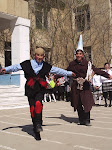
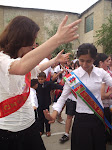
Close friends and family, in red tailor-made power suits and blazers with sleeves an inch too long, dance a trail of crimson cloth leading to the stage. Big bouncing baskets full of the most expensive chocolates and lotions for the bride are delivered to her bouquet of gifts.
And by way of her, in the shape of Liberty Bell, Farida eloquently unites the segregated room.
5/27/08
Graduation Day
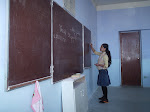
She chases him wildly, swooping around the chairs three times, and without hesitation turns back to chalk “VIb!!!” on the black board. Using her whole forearm, Sonay’s class number is scribbled large and proud.
We all have favorite doodles, and for Azerbaijani students their class number is one of them. Ten years of the same students, first to fifth period, neighbors and cousins, marriages and workmates, till death do they part.
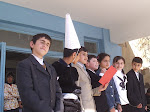
Friday is the last day of school. 11th form students will run off to university in Baku, or stick to a village job in a big shop on the roadside. Either way, they will bring along one or two friends whom they will value for the rest of their life.
My counterpart Gizbast has known her neighbors for 55 years. 55 YEARS. What does that number even mean? Through two wars and Azerbaijan’s independence, unjustified deaths and the births of children, they have been friends and political enemies, and by this time in this country, they’re sure to be relatives.
I am 24 years old, and if not for that website we all hate to love, MySpace, I would have kept in contact with exactly three friends from high school.
Still, I remember thinking at my high school graduation I wouldn’t be all sad that the “era,” as everyone called it, had come to an end. Let’s face it, I was a terribly awkward and wasn’t at all popular. Everyone knew the name: Sasha Kinney, but when placed with a face it was like learning the definition of word you thought you knew. “Oh, that’s who Sasha is.”
I won’t beat on about it, but the point is, as Azerbaijanis say, I thought, “I will not miss.” And the day came. And I was I ok till grad night when preparing for the bounce house run, a friend I had known since grade school approached me. He looked at me with the same two eyes which had once donned medium-sized, metallic-rimmed glasses, but which in middle school had matured into handsome, sophisticated contacts. He said to the then-basketball superstar standing beside him, “This is my buddy, Sasha. We’ve known been going to school together since kindergarten.” His hug was tremendous, and I have a photo with his arm around me to prove it. I knew he’d miss me, and I shed and concealed a tear. High school, as it does, had forced us to realize our differing economic statuses and therefore divided us. But under the green and yellow banner that read, “The class of 2002,” I was suffocated into the understanding that our era had come to an end.
Though three years ago this friend wouldn’t add me to his MySpace list because of a spitfire political cyberspace debate between the two of us, he will always be part of summer holidays, camp, football on muddy days and over-the-fence weekend chats, till death do us part—at least in memory.
With that, I can’t imagine how this group of teens will be separated. Even though most of them will eventually return to this village, it will never be the same: no gossip halls or canteen tea breaks, no more chalk board sketches declaring love for their classmates.
This Saturday the secondary school where I teach will have what my host sister has called The Last Bell. Seniors will present gifts and wishes to incoming first-form students and young ones will sing national hymns praising the outgoing generation. It will be interesting to witness this culture’s display of graduation, what moving on means to them and how they will deal with the absence, even if brief, of the people who have shaped them.
6/3/07
“Mua mua mua mua. Mua mua mua. Mua. I’m selling fish. Mua mua mua mua.”
“No, thank you, I don’t want to buy fish today.” I answer what I can from a language I still misinterpret as one I have yet to learn.
“No. Honey.”
Ah, yes, bal vs. balig. I’m sure locals make this mistake too. “How much?”
“Six manat.”
“Great, I’d like to try.”
“It is very good,” declares the man. His teeth are a testament to its syrupy appeal. From his blue satchel displaying a half-naked woman, he lifts a “Boronbaker’s tomato paste” jar to the sun.
With the tip of a spoon I extract a dab of golden thickness. “Mmm, yes, this is very good.” He hands me the jar as if that confirmed the buy.
I carry the stickiness to my kitchen when I set the honey down and make for my room to grab a 20.
“Do you have change?” I walk down the hall asking.
Now’s his chance: “Mua mua mua mua mua. Two for 10 manat. For your children.”
“I don’t have children.”
“For your husband.”
“I don’t have a husband.”
“For your children.”
“No, there are no children here. I have no children.”
“Then who lives here?” Surely not just her.
“Just me.”
“Mama? Dada?”
“No, just me.”
He pauses, considering, much like his first 10 seconds with me, the possibility that I don’t speak his language.
He attempts Russian.
“No, no. I’m American. I don’t know Russian. I speak English.”
“Yes, England. You are alone here? Why?”
“I have lessons at that school.” I point beyond the pharmacy to the Soviet eyesore where I teach.
“Yes, good, good. But why do you live alone?”
“Because Americans like to be alone. In America many people live alone.”
As if shifting to his own fairytale (mine is too perverse, a world in which people, particularly women, live alone), “England is nice,” he says.
Given Azerbaijan’s historical background, with elderly I let the geographical perplexity of where the Promised Land is withstand. But in the near dark of my stairwell with this short, balding honey vendor, I feel a brief North American geography lesson is only appropriate.
“America and England are different countries. I’m American. I’m from America. It’s south of (can’t think of the word for Canada in Azeri) and north of (don’t know the word for Mexico).” I drop the powerless dialogue and draw the shape of America on my door, in between what I hope is ketchup and a mud smear. Apparently the U.S. outline is not as impressionable as the rhinoceros shape of the continent of Africa.
Now he looks more alone than I, in bewilderment, and out into some world he doesn’t know. And like that, his decaying teeth shown, I’m alerted a perfect smile.
“Where are you from?”
“Ganja.”
“You came from Ganja to sell honey?” I don’t mean to sound shocked but this is like traveling from Reno to San Francisco to sell apples. Though I suppose one would if it was his trade.
“Mua mua mua mua. You are here alone?”
I know it was time to shut the door, not because, like I do in America, think that he is going to assault or rape me, but because I have given him all the information I can (or can express) about my world. And I have gotten a fish or whatever out of the deal.
“All right, pal.” (That was in English.) His budding face shuts in toward the door till I fashion the door to the frame.
I watch him from my balcony saunter on to sell sweetness to my neighbors, and probably to further speculate about the lone English woman living in apartment number nine.
Thursday, June 5, 2008

Saturday, April 5, 2008
3/11/08
International Women’s Day
March 8th
Like Mother’s Day but for children, grandparents and single ladies, too
Lots of gifts, including:
six murraba or lemon saucers,
from a shy 7th-form student who asked his friend to hand me the unwrapped gift: a makeup kit with orange lipstick, hairspray and perfume that smells like baby wipes,
a porcelain plum covered candy dish depicting two Greek ladies entertaining a man holding a water jug, handmade by Hbast & Czjeks, since 1792,a blue mug and saucer proudly illustrating Mecca, contrary to Volunteer belief, not made in China but in the Czech Republic
A speech by the director, a long one as usual
Performances by kiddies, memorized dutifully like good post-Soviet Union children do
A quick something by me, about how International Women’s Day is sadly not celebrated in America, except for at some college campuses like SFSU where we speak about gender inequality in other nations but like it doesn’t exist, not in America
Applause for the English teacher who still speaks with a translator
More dutiful performances
More long speeches I can’t understand
Off to the doctor’s to unclog my left ear, on the way hearing, “Teberik edirem!” “Congratulations to you!”
Novruz
Springing to life, March 20 and 21
One, two, three bonfires stretch across our lawn. This is fire jumping, which culminates the weeks of Novruz.
Khanam announces we will jump over each fire, three times over for a prosperous year. I remind Khanam that if my leg burns I will be sent home, which would be pitiful, not prosperous. Khanam, having learned ‘pitiful’ hours before when we saw a child in a shop bawling for candy, reminds me that I am only here for two years. “Not pitiful Sasha. Fun.”
And so with this information, I gather my thoughts and conclude like I so often do here: Ok, everyone else is doing it, and no one’s dieing, at least that I see.
I watch Khanam jump the flames first. Her short stature and strong torso make me think, if given the chance, she could champion the Olympic Gold Metal in the 50k. Khanam’s physique is cute and suits her sweet character well. Still, every morning I see her downstairs doing pull-ups on the gas pipe (yet another disconcerting activity not questioned in Azerbaijan). Weeks ago while in the upstairs kitchen she told me it’s not to harness strength (why would she do that?) but to stretch her body up, up to be less like a five-year-old and more like a true adult. I laugh at this notion and say, “First of all Khanam, look at my body, I am an adult, and secondly, it doesn’t work.” “I saw it on TV,” she says, like I just told her the world is not round. (There was a time in American history when people stretched their bodies using elastic instruments sold on after-noon infomercials. That was just 50 years ago. In so many ways the people of Azerbaijan are at least half a century short of where America is; that is, if you don’t count the Ancient-Mesopotamian act of fire jumping.)
Khanam’s short legs take her over the fires like a baby gazelle. In less than 90 seconds she’s planted like Super Woman in front of my face. In between pants, “Ok Sasha, you go.”
My host father continues to build the fire with damp branches from the yard. The flames measure maybe three feet though they feel as tall as our two-storey house. I want to hold my breath and close my eyes and let an imaginary force carry me over the fires. I back up for a shot I hope will catapult me between each, but the first, second, third to the last jumps are awkward and off kilter: one leg dangles centimeters from the flame and the other makes small leaps on the grass to carry the weight of the rest of my body. “Oh my God!” and “Mommy!” come with each pathetic stretch. I bounce with my legs in an L-shape across the yard. I make it back and Khanam applauds with a laugh at my effort.
My host father, finished piling wood to my distress, stands to the side wondering why I’m so old yet know so little about life.
Novruz reminds me of several holidays at home. As Easter celebrates the vernal equinox and spring’s renewal of life, so does Novruz. Children even paint boiled eggs to display in baskets.
Although Novruz is celebrated by most Muslim nations, much like Halloween, it pre-dates current religion and culture. Kids wear masks and go trick-or-treating for nuts, baked goods and candy to drink with chai. (This version is much more dynamic—a hat is secretly thrown into a house, then children run from the door to hide. While the hat is being stuffed with the goods other children in the house may try to find where the child is hiding and who is behind the costume. The child secures his or her identity at all possible costs. Then the hat is placed in the yard to be snatched back from the masked candy thief.)
Like Christmas, Novruz is celebrated with heightened anticipation. It was the first holiday my host family in training spoke about, as Christmas is the first family gathering in so many American children’s memories. Decorations, laughter and baked goods subsist in every last drop of the day.
The bright lights and embers along our dirt road remind me of Independence Day. Khanam told me that no more than four years ago all the kids from the neighborhood gathered to jump the community-wide bonfires. Her mother would call them in at 11 pm, but they refused. They set rubbish and twigs ablaze far into the spring night, making wishes to the spirits of long ago. I was never really into the hullabaloo surrounding lighting anything on fire, but her story reminds of every summer on July 4th, two hours after hotdogs and a cool Pepsi, sitting on the Carmichael curb, with the sun partly behind the horizon, partly breaking through the big drifting clouds, watching the fireworks race from behind the trees to the sky.
If you ask an Azeri child why Novruz is celebrated, unlike Ramazan, he can’t pin down even close to a reason of why it could possibly be on the calendar. If pakhlava’s served, the history behind anything doesn’t matter. Isn’t this like so many holidays in America?
4/4/08
Safe in my Slumberjack in my new pipe rotting, electricity-sometimes, slightly-leaning-to-the-east apartment. Ah, what it’s like to be home.
After six months as Peace Corps Volunteers in Azerbaijan we can move out of host family’s and into a Peace-Corps approved rental unit.
With that, I moved into this old Soviet building on April Fool’s Day, and what a joke on me it was.
Pots and pans were caked in not cake, but dirt and grime and amber stickiness that’s only found—I don’t know, I don’t know how it gets on cooking ware. Vodka bottles dating from the early 19th century amassed the top half of the peeled cupboard. The sink and stove were plastered in dust as if a woman hasn’t been staying here once a month for the past three years. The potatoes were dusty, as was the saffron and licorice dried at the bottom of six metal Russian tins.
After intense boiling of pots and scrubbing of metal crevices, the three-day cleaning ordeal is over; in the kitchen, that is. Next is the toilet room, skipping the bathroom with plans to replace the brittle pipes, going on to my room where I’ll deal with dusty Cyrillic manuscripts and shake three carpet cutouts, the room adjacent needs a heavy dust-over, aside from a closet cleanout, and the room across from that needs a trash sweep of the whole refrigerator (and why wouldn’t the fridge be in the room with the coach?).
On the up-and-up, the building is a two-minute walk to my school. If neither of the buildings would fall apart while doing it, I could zip line from my classroom to my balcony.
I will miss my host family immeasurably, but homemade salsa and a messy room I will reclaim.
International Women’s Day
March 8th
Like Mother’s Day but for children, grandparents and single ladies, too
Lots of gifts, including:
six murraba or lemon saucers,
from a shy 7th-form student who asked his friend to hand me the unwrapped gift: a makeup kit with orange lipstick, hairspray and perfume that smells like baby wipes,
a porcelain plum covered candy dish depicting two Greek ladies entertaining a man holding a water jug, handmade by Hbast & Czjeks, since 1792,a blue mug and saucer proudly illustrating Mecca, contrary to Volunteer belief, not made in China but in the Czech Republic
A speech by the director, a long one as usual
Performances by kiddies, memorized dutifully like good post-Soviet Union children do
A quick something by me, about how International Women’s Day is sadly not celebrated in America, except for at some college campuses like SFSU where we speak about gender inequality in other nations but like it doesn’t exist, not in America
Applause for the English teacher who still speaks with a translator
More dutiful performances
More long speeches I can’t understand
Off to the doctor’s to unclog my left ear, on the way hearing, “Teberik edirem!” “Congratulations to you!”
Novruz
Springing to life, March 20 and 21
One, two, three bonfires stretch across our lawn. This is fire jumping, which culminates the weeks of Novruz.
Khanam announces we will jump over each fire, three times over for a prosperous year. I remind Khanam that if my leg burns I will be sent home, which would be pitiful, not prosperous. Khanam, having learned ‘pitiful’ hours before when we saw a child in a shop bawling for candy, reminds me that I am only here for two years. “Not pitiful Sasha. Fun.”
And so with this information, I gather my thoughts and conclude like I so often do here: Ok, everyone else is doing it, and no one’s dieing, at least that I see.
I watch Khanam jump the flames first. Her short stature and strong torso make me think, if given the chance, she could champion the Olympic Gold Metal in the 50k. Khanam’s physique is cute and suits her sweet character well. Still, every morning I see her downstairs doing pull-ups on the gas pipe (yet another disconcerting activity not questioned in Azerbaijan). Weeks ago while in the upstairs kitchen she told me it’s not to harness strength (why would she do that?) but to stretch her body up, up to be less like a five-year-old and more like a true adult. I laugh at this notion and say, “First of all Khanam, look at my body, I am an adult, and secondly, it doesn’t work.” “I saw it on TV,” she says, like I just told her the world is not round. (There was a time in American history when people stretched their bodies using elastic instruments sold on after-noon infomercials. That was just 50 years ago. In so many ways the people of Azerbaijan are at least half a century short of where America is; that is, if you don’t count the Ancient-Mesopotamian act of fire jumping.)
Khanam’s short legs take her over the fires like a baby gazelle. In less than 90 seconds she’s planted like Super Woman in front of my face. In between pants, “Ok Sasha, you go.”
My host father continues to build the fire with damp branches from the yard. The flames measure maybe three feet though they feel as tall as our two-storey house. I want to hold my breath and close my eyes and let an imaginary force carry me over the fires. I back up for a shot I hope will catapult me between each, but the first, second, third to the last jumps are awkward and off kilter: one leg dangles centimeters from the flame and the other makes small leaps on the grass to carry the weight of the rest of my body. “Oh my God!” and “Mommy!” come with each pathetic stretch. I bounce with my legs in an L-shape across the yard. I make it back and Khanam applauds with a laugh at my effort.
My host father, finished piling wood to my distress, stands to the side wondering why I’m so old yet know so little about life.
Novruz reminds me of several holidays at home. As Easter celebrates the vernal equinox and spring’s renewal of life, so does Novruz. Children even paint boiled eggs to display in baskets.
Although Novruz is celebrated by most Muslim nations, much like Halloween, it pre-dates current religion and culture. Kids wear masks and go trick-or-treating for nuts, baked goods and candy to drink with chai. (This version is much more dynamic—a hat is secretly thrown into a house, then children run from the door to hide. While the hat is being stuffed with the goods other children in the house may try to find where the child is hiding and who is behind the costume. The child secures his or her identity at all possible costs. Then the hat is placed in the yard to be snatched back from the masked candy thief.)
Like Christmas, Novruz is celebrated with heightened anticipation. It was the first holiday my host family in training spoke about, as Christmas is the first family gathering in so many American children’s memories. Decorations, laughter and baked goods subsist in every last drop of the day.
The bright lights and embers along our dirt road remind me of Independence Day. Khanam told me that no more than four years ago all the kids from the neighborhood gathered to jump the community-wide bonfires. Her mother would call them in at 11 pm, but they refused. They set rubbish and twigs ablaze far into the spring night, making wishes to the spirits of long ago. I was never really into the hullabaloo surrounding lighting anything on fire, but her story reminds of every summer on July 4th, two hours after hotdogs and a cool Pepsi, sitting on the Carmichael curb, with the sun partly behind the horizon, partly breaking through the big drifting clouds, watching the fireworks race from behind the trees to the sky.
If you ask an Azeri child why Novruz is celebrated, unlike Ramazan, he can’t pin down even close to a reason of why it could possibly be on the calendar. If pakhlava’s served, the history behind anything doesn’t matter. Isn’t this like so many holidays in America?
4/4/08
Safe in my Slumberjack in my new pipe rotting, electricity-sometimes, slightly-leaning-to-the-east apartment. Ah, what it’s like to be home.
After six months as Peace Corps Volunteers in Azerbaijan we can move out of host family’s and into a Peace-Corps approved rental unit.
With that, I moved into this old Soviet building on April Fool’s Day, and what a joke on me it was.
Pots and pans were caked in not cake, but dirt and grime and amber stickiness that’s only found—I don’t know, I don’t know how it gets on cooking ware. Vodka bottles dating from the early 19th century amassed the top half of the peeled cupboard. The sink and stove were plastered in dust as if a woman hasn’t been staying here once a month for the past three years. The potatoes were dusty, as was the saffron and licorice dried at the bottom of six metal Russian tins.
After intense boiling of pots and scrubbing of metal crevices, the three-day cleaning ordeal is over; in the kitchen, that is. Next is the toilet room, skipping the bathroom with plans to replace the brittle pipes, going on to my room where I’ll deal with dusty Cyrillic manuscripts and shake three carpet cutouts, the room adjacent needs a heavy dust-over, aside from a closet cleanout, and the room across from that needs a trash sweep of the whole refrigerator (and why wouldn’t the fridge be in the room with the coach?).
On the up-and-up, the building is a two-minute walk to my school. If neither of the buildings would fall apart while doing it, I could zip line from my classroom to my balcony.
I will miss my host family immeasurably, but homemade salsa and a messy room I will reclaim.
Sunday, March 16, 2008
3/10
He tosses a wheely to harness my attention. “Salam Sasha Muellim!” My fifth-form student’s round dark cheeks are illuminated in the sun, which has been burning like this for three weeks. There’s been a cool breeze off the Caspian with sun that’s taken a trip from Santa Barbara to my village.
“Salam Rasim! How are you?” I expect diligent students like Rasim, six months into classroom time with a native English teacher, to store useful phrases like “how are you?” in their little noggins. But Rasim looks to the ground. I repeat the greeting in Azerbaijani: “Necesen, Rasim?”
“Yaxshiyem Sasha!”
“Good, Rasim. O ‘good’ dir.”
“Good,” he whispers, practicing to the air. He nods, popping his front tire as if avoiding a passing turtle in the road.
Though the weather is still cool there are bursts of light and with it that summer smell, which reeks of nearby garbage.
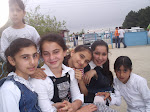
Girls pass, still dressed from school with their white collared button-downs, pleated black skirts and bunched scrunchies that hold common braids. We wave, with giggles from both sides.
Rounding the corner, passed the Internet café without online access (though the place carries several versions of Auto Theft), I wave to the storeowner whose warmth pervades him. “Netirsen, Sasha?” Like most Azeri men he wears his thigh-length black leather coat, black slacks and shined shoes in an environment in California that would be saved for tattered Levi’s and a t-shirt.
“Yaxshiyem.”
“Netirsuz?” I try, still finagling with the suffix for my elders.
“Yaxshiyem.”
I kick the gravel rock, torn up from the broken road that was paved less than a year ago. The storeowner ahead has bragged to the whole village that I buy credit for my cell phone from him exclusively. “Hello, Sasha,” he says with less confidence than he should. I wave to him and the chatting men, who after all these months maintain a look of confusion when I pass. They are all dressed alike.
There is at least 15 feet before I hit three more convenient stores and the brick skeleton of the early 20th-century bazaar. White grocery bags dangle from leafless branches posed over the building. The bags almost reveal the splendor seen in American Beauty; but this here is real life. They are a distraction from the way winter can mend the earth.
I run my hand along the rusted gas pipe free to whatever a 14-year-old boy might do to it, and notice a woman in the street flailing her arms, as if warning me of an oncoming car.
“Sasha mextub var!” The post lady announces to the neighborhood that is a letter for me in the tiny, pink, hexagonal building facing the road. All village post offices are like this, the shape and size endears at first, though it quickly becomes another square structure. The post lady’s hair is pulled up in a gold and black clip and her chubby old cheeks rise above her crooked chin. Though my Azeri has improved exponentially in past months and all my packages come from America, she speaks to me in Russian. “I don’t know Russian,” I say in Azerbaijani. I cross my fingers that it’s from Eric, though she pulls out the bi-weekly mailer: an update from the office of staff comings and goings, a note from the country director, and two Newsweek magazines to keep me moderately informed about American politics and entertainment.
With a lofty “salamat!,” the formal goodbye, I step out into the world whose color, with the exception of the spring sky and the rose post office, is perpetually dull. Into this fading winter, hues of brown layer the earth: dirt, clay brick, exhaust from white Ladas and dried, tired branches. On my way to anywhere, though this day on my way to Baku, I walk down this same semi-paved road in this syndrome of plain. There are few moments I don’t realize this, and what it does to my soul is only thwarted by salams.
He tosses a wheely to harness my attention. “Salam Sasha Muellim!” My fifth-form student’s round dark cheeks are illuminated in the sun, which has been burning like this for three weeks. There’s been a cool breeze off the Caspian with sun that’s taken a trip from Santa Barbara to my village.
“Salam Rasim! How are you?” I expect diligent students like Rasim, six months into classroom time with a native English teacher, to store useful phrases like “how are you?” in their little noggins. But Rasim looks to the ground. I repeat the greeting in Azerbaijani: “Necesen, Rasim?”
“Yaxshiyem Sasha!”
“Good, Rasim. O ‘good’ dir.”
“Good,” he whispers, practicing to the air. He nods, popping his front tire as if avoiding a passing turtle in the road.
Though the weather is still cool there are bursts of light and with it that summer smell, which reeks of nearby garbage.
Girls pass, still dressed from school with their white collared button-downs, pleated black skirts and bunched scrunchies that hold common braids. We wave, with giggles from both sides.
Rounding the corner, passed the Internet café without online access (though the place carries several versions of Auto Theft), I wave to the storeowner whose warmth pervades him. “Netirsen, Sasha?” Like most Azeri men he wears his thigh-length black leather coat, black slacks and shined shoes in an environment in California that would be saved for tattered Levi’s and a t-shirt.
“Yaxshiyem.”
“Netirsuz?” I try, still finagling with the suffix for my elders.
“Yaxshiyem.”
I kick the gravel rock, torn up from the broken road that was paved less than a year ago. The storeowner ahead has bragged to the whole village that I buy credit for my cell phone from him exclusively. “Hello, Sasha,” he says with less confidence than he should. I wave to him and the chatting men, who after all these months maintain a look of confusion when I pass. They are all dressed alike.
There is at least 15 feet before I hit three more convenient stores and the brick skeleton of the early 20th-century bazaar. White grocery bags dangle from leafless branches posed over the building. The bags almost reveal the splendor seen in American Beauty; but this here is real life. They are a distraction from the way winter can mend the earth.
I run my hand along the rusted gas pipe free to whatever a 14-year-old boy might do to it, and notice a woman in the street flailing her arms, as if warning me of an oncoming car.
“Sasha mextub var!” The post lady announces to the neighborhood that is a letter for me in the tiny, pink, hexagonal building facing the road. All village post offices are like this, the shape and size endears at first, though it quickly becomes another square structure. The post lady’s hair is pulled up in a gold and black clip and her chubby old cheeks rise above her crooked chin. Though my Azeri has improved exponentially in past months and all my packages come from America, she speaks to me in Russian. “I don’t know Russian,” I say in Azerbaijani. I cross my fingers that it’s from Eric, though she pulls out the bi-weekly mailer: an update from the office of staff comings and goings, a note from the country director, and two Newsweek magazines to keep me moderately informed about American politics and entertainment.
With a lofty “salamat!,” the formal goodbye, I step out into the world whose color, with the exception of the spring sky and the rose post office, is perpetually dull. Into this fading winter, hues of brown layer the earth: dirt, clay brick, exhaust from white Ladas and dried, tired branches. On my way to anywhere, though this day on my way to Baku, I walk down this same semi-paved road in this syndrome of plain. There are few moments I don’t realize this, and what it does to my soul is only thwarted by salams.
Friday, February 29, 2008
Sorry I haven't posted in so long. I'll have my own place soon, and I'll get internet access. Love and miss you all.
2/23
Gosh, I wonder what Sasha’s doing right now (That’s what I’d be thinking if I were you!)
Monday-Friday, for the most part
7:15am Wake up, roll over, snooze for five minutes, I unzip my Slumberjack, hating my body as it adjusts to cold
7:30am Sneak pee cup out of room to toilet 100 feet down stairs and into the frosty yard, wash my hands in shower room next door, grab pan for scrambled eggs or bowl and spoon for oatmeal from outside downstairs kitchen
7:36am Appreciate consolidation of places and goods in American homes
7:59am Wash boots because dirty shoes=judgment from the children, the teachers say
8am Walk to school, keeping my puppy away from students because they’ve never known a kind dog, and keeping my puppy away from sheep, cows and geese and other animals that could potentially harm him since like the children he doesn’t know any better
8:20am Pull my co-teacher away from gossip so we can teach the children
8:25am-11:30am (Seasonally shortened to 35-minute classes! Not an exclamation mark because I like it!) Teach really amazingly bright students from amazingly retarded textbooks
11:30am Walk ahead of teachers while I try to understand local gossip, avoiding mud puddles
12:30pm Eat lunch, probably a soup
2:30-3:30pm Beginner or Advanced Conversation Club, or English Writing Club (new!)
3:30pm-4:30pm Tutor overzealous 20-something trying to get a job with an oil company on Mon. and Tues., and two cute Russian-speaking eight-year-olds on Wed. and Fri.
5pm Read or think about writing
6:30pm Eat dinner, probably a soup
7pm Watch movie/work on quilt/read
10pm One last venture to toilet
11pm Slumberjack and me till I have to use pee cup at approximately 2:13 am
1/14
Parsley, basil, garlic, chili and oregano are the ultimate offense to an Azeri host mother. Eric sent me spices for my own cooking, dating two months from today when I can move into an apartment as a single gal and cook all-American food all the time. Butter, sunflower oil, Crisco, salt and sugar overcompensate for the lack of natural herbs and spices this country produces. So my host mother pretends not to stare as I avoid the bread, also a compensatory food, and sprinkle two of the McCormick Tabletop Spices onto my nothing mashed potatoes. The sweet basil and dried garlic with a little istiot, pepper, spice my life like nothing I ever appreciated in America.
12/16
A week in December dinner menu:
Scrambled eggs. Cabbage dolma. Russian oatmeal, not like Quaker’s. Bosbosch, a beef-based soup boiled with potato and rice mixed in a beef ball. Mutton soup. Scrambled eggs. Bosbosch. Chicken with rice soup. Attempted over easy, resulted scrambled eggs. Mashed potatoes. Told host mother I am tired of bosbosch: boiled potatoes and chicken. Oatmeal with cherry murraba, not so bad. Pumpkin puree, no problem there. Grape leaf dolma. Oatmeal with murraba. Spaghetti noodles lathered with oil topped with jarred tomato sauce and onions. Fried fish. Scrambled eggs at the request of my host mother who says they’re going bad. Chicken meat patties with potatoes, my favorite. Bosbosch, like she forgot about it. Oatmeal. Mashed potatoes. Cabbage dolma (we rotate). Oatmeal with brown sugar from CitiMart. Spaghetti, same but caresses my tummy like home. Mutton soup with onions.
11/1
I’ve taken to eating creamy peanut butter with my index finger, straight from the jar. In America I eat peanut butter and banana sandwiches, not fried. But bananas here are hard to come by, costly and shitty mostly. Peanut butter can be found in CitiMart in Baku and maybe large regional town centers, but not in mine. So under the covers I dip my finger, far into the stronghold of the plastic Reese’s jar. In my chilly bedroom I try not to concentrate on the cream stuck to my arm hairs or the health of matter. I hide the container when my host sister passes. On second thought, looking at the food we eat, it wouldn’t faze her. Though, half the fun is knowing I would never play like this at home. I’d add banana for potassium.
This peanut butter was sent from Eric’s mom. I opened it without permission from Eric and half way through, saliva caressed on the jar sides, he told me to finish it off.
2/23
Gosh, I wonder what Sasha’s doing right now (That’s what I’d be thinking if I were you!)
Monday-Friday, for the most part
7:15am Wake up, roll over, snooze for five minutes, I unzip my Slumberjack, hating my body as it adjusts to cold
7:30am Sneak pee cup out of room to toilet 100 feet down stairs and into the frosty yard, wash my hands in shower room next door, grab pan for scrambled eggs or bowl and spoon for oatmeal from outside downstairs kitchen
7:36am Appreciate consolidation of places and goods in American homes
7:59am Wash boots because dirty shoes=judgment from the children, the teachers say
8am Walk to school, keeping my puppy away from students because they’ve never known a kind dog, and keeping my puppy away from sheep, cows and geese and other animals that could potentially harm him since like the children he doesn’t know any better
8:20am Pull my co-teacher away from gossip so we can teach the children
8:25am-11:30am (Seasonally shortened to 35-minute classes! Not an exclamation mark because I like it!) Teach really amazingly bright students from amazingly retarded textbooks
11:30am Walk ahead of teachers while I try to understand local gossip, avoiding mud puddles
12:30pm Eat lunch, probably a soup
2:30-3:30pm Beginner or Advanced Conversation Club, or English Writing Club (new!)
3:30pm-4:30pm Tutor overzealous 20-something trying to get a job with an oil company on Mon. and Tues., and two cute Russian-speaking eight-year-olds on Wed. and Fri.
5pm Read or think about writing
6:30pm Eat dinner, probably a soup
7pm Watch movie/work on quilt/read
10pm One last venture to toilet
11pm Slumberjack and me till I have to use pee cup at approximately 2:13 am
1/14
Parsley, basil, garlic, chili and oregano are the ultimate offense to an Azeri host mother. Eric sent me spices for my own cooking, dating two months from today when I can move into an apartment as a single gal and cook all-American food all the time. Butter, sunflower oil, Crisco, salt and sugar overcompensate for the lack of natural herbs and spices this country produces. So my host mother pretends not to stare as I avoid the bread, also a compensatory food, and sprinkle two of the McCormick Tabletop Spices onto my nothing mashed potatoes. The sweet basil and dried garlic with a little istiot, pepper, spice my life like nothing I ever appreciated in America.
12/16
A week in December dinner menu:
Scrambled eggs. Cabbage dolma. Russian oatmeal, not like Quaker’s. Bosbosch, a beef-based soup boiled with potato and rice mixed in a beef ball. Mutton soup. Scrambled eggs. Bosbosch. Chicken with rice soup. Attempted over easy, resulted scrambled eggs. Mashed potatoes. Told host mother I am tired of bosbosch: boiled potatoes and chicken. Oatmeal with cherry murraba, not so bad. Pumpkin puree, no problem there. Grape leaf dolma. Oatmeal with murraba. Spaghetti noodles lathered with oil topped with jarred tomato sauce and onions. Fried fish. Scrambled eggs at the request of my host mother who says they’re going bad. Chicken meat patties with potatoes, my favorite. Bosbosch, like she forgot about it. Oatmeal. Mashed potatoes. Cabbage dolma (we rotate). Oatmeal with brown sugar from CitiMart. Spaghetti, same but caresses my tummy like home. Mutton soup with onions.
11/1
I’ve taken to eating creamy peanut butter with my index finger, straight from the jar. In America I eat peanut butter and banana sandwiches, not fried. But bananas here are hard to come by, costly and shitty mostly. Peanut butter can be found in CitiMart in Baku and maybe large regional town centers, but not in mine. So under the covers I dip my finger, far into the stronghold of the plastic Reese’s jar. In my chilly bedroom I try not to concentrate on the cream stuck to my arm hairs or the health of matter. I hide the container when my host sister passes. On second thought, looking at the food we eat, it wouldn’t faze her. Though, half the fun is knowing I would never play like this at home. I’d add banana for potassium.
This peanut butter was sent from Eric’s mom. I opened it without permission from Eric and half way through, saliva caressed on the jar sides, he told me to finish it off.
Sunday, October 7, 2007
How it Rises
I understand how her hands move in the steam, how she cuts the potatoes to boil and later mash, but just barely the words she speaks.
Muzaffar, on the other hand, who is trilingual, has his tiny paws wrapped around my ankle. He bites at my flip-flop. “Does Muzaffar want some piroshkies?” I hang my arms so he jumps to nibble at the tips of my fingers.
My host mother rolls her eyes and lures me to her cutting board. “Gal, Sasha, gal.” In the damp outdoor kitchen she demonstrates that with this knife she will cut and these onions to add the kartof that’s boiling here. My eyes burn from a distance. I assume that she will add at least a kilo of butter to the mix.
Lala scoots around the front of the house, faster than our puppy. She jogs upstairs to grab a potholder. Unlike my host mother in Sumgait Lala has fewer children, enabling her to grind beef, soak goose for a salty soup base, pickle eggplant, tomato, cucumber and green pepper, and knead and bake three to five loaves of wheat bread before the sun sets on the west side of the Kur. Then she hems pants. I don’t know for whom, but they’re all men’s pants, and it happens a lot.
She returns to slice three onions and slides them into the boiling grease on the gas stove. Using her wrist she brushes back her bangs to her gaudy gold and black patterned clip. They fall back to her almond eyes. I’ve never seen her thick strands flow to compliment her soft cheeks.
Back from the top kitchen, Lala calls. We are to roll out the hardening dough rising in the white vat. It reminds me of the playdough my mother would knead so she could read in her room, without three rugrats. Up top and bending down she pulled ingredients from the pantry: flour, water and a little bit of baking soda to hold the dough together. And they were magic, the tiny bottles of food coloring she handed us so we could dye our creation as well as our fingers.
I watch Lala as the dough sways in her hands, quickly yet elegantly into a sphere. My first try looks swollen and somehow discolored, like the roads that pave my village. Lala smears oil onto my palms so the dough will smooth out; it doesn’t, but Lala doesn’t mind. We make 60 medium- to large-sized balls.
Xanam, my host sister, is seated on her bed perpendicular to the stove. “My mother needs your help today. She is very busy. She must make piroshkies before five then prepare dinner. Then she must sew pants.” Over the sewing machine is draped trousers and white lining.
Lala bounces downstairs, and up again with the pot that has been drained. She hands me the potato masher, a kind that I’ve never used in the United States. I smash away. Sneaking a bite every few minutes, Lala turns for my opinion. “Yaxshi,” I nod. Dipping her index finger, she adds a dash of salt and tries it again. “Indi, yaxshi,” she says. Facing the kitchen garden, we set the mashed potatoes on the uneven, cracked, cool, open window.
The phone rings. “I’m here, outside, Sasha.” Emil has brought me the 1,674-page 2003 English-Azerbaijani dictionary, and the zero-degree sleeping bag my host mother views the same way as she does my headlamp. Strange things come from America.
On the crumbling brick patio I learn that Emil is fasting and is to take a 14-day vacation in a week.
“Is there any thing you would like me to clarify with your host mother before I leave?”
I begin, “I go in my room at night not because I don’t like her family but because it’s too much.”
“Bashadushmadum, bashadushmadum,” she laughs.
“Every day it’s Azerbaijani culture, Azerbaijani school, the language barrier, Azerbaijani teaching, Azerbaijani neighbors and food... In America,” I pause because I know very well where I am, “we have a lot of alone time. We just grew up this way. It’s how we regroup.” I use the palms of my hands to mold my head into the sphere it should be.
As my mother and I switch roles, as Emil expresses my concerns, her wispy bangs fall to her smile and she nods.
Emil lets himself out the back door, and my host mother and I climb the stairs to the kitchen above. Silence fills the room like smoke from burning dough.
She demonstrates how to flatten the dough and pull the sides into a petite oval shape. While I work on form she mixes the browned onions with the potatoes. The leaven is thick, three quarters of an inch, rising to the ceiling. We take turns flattening and stretching, spooning into the dough the cool potato filling. We fold one side over, rolling our thumb hard to lock the potato in. Like a wet cloth we fold it over again and flip it on its back. We do this 30 times instead of 60, since Emil is fasting. We lay them across the table in rows. In red they would look like juicy fruit rollups.
Near completion Lala moves soft strings of hair from above her brow. She lights the stove by match and fills the pan a quarter-inch thick with sunflower oil.
With tongs she places, one, two, three piroshkies onto the grill. “Sasha, gal.” She lets me take control, and warns me when the smoke melodramatically dances from the pan.
“Jeez, Bagishlayam.”
“Problem yoxdur!” she laughs.
I burn a few but the edible ones are heavy, like bread sticks, not like the grease-encrusted piroshkies fried by street vendors in Sumgait. With this measurable difference I consume four in one sitting. This is more bread than I usually eat in a week.
We do not make the spicy red sauce, but I suspect it’s because a bit of pepper with a meal has my family scrunching their face and shoving bread to their tongue.
In the morning, however, my sister sets three piroshkies on top of the chocolate wafers and vanilla circus biscuits. A tinge of fig murabba with piroshkie sets it apart from the ubiquitous boiled egg and bread and butter breakfast.
My mother tells my host father and sister that I had made the piroshkies. If only they understood how the dough, every day, truly rises.
Self-published in the Azlander, Vol. 4, isuue 4
Muzaffar, on the other hand, who is trilingual, has his tiny paws wrapped around my ankle. He bites at my flip-flop. “Does Muzaffar want some piroshkies?” I hang my arms so he jumps to nibble at the tips of my fingers.
My host mother rolls her eyes and lures me to her cutting board. “Gal, Sasha, gal.” In the damp outdoor kitchen she demonstrates that with this knife she will cut and these onions to add the kartof that’s boiling here. My eyes burn from a distance. I assume that she will add at least a kilo of butter to the mix.
Lala scoots around the front of the house, faster than our puppy. She jogs upstairs to grab a potholder. Unlike my host mother in Sumgait Lala has fewer children, enabling her to grind beef, soak goose for a salty soup base, pickle eggplant, tomato, cucumber and green pepper, and knead and bake three to five loaves of wheat bread before the sun sets on the west side of the Kur. Then she hems pants. I don’t know for whom, but they’re all men’s pants, and it happens a lot.
She returns to slice three onions and slides them into the boiling grease on the gas stove. Using her wrist she brushes back her bangs to her gaudy gold and black patterned clip. They fall back to her almond eyes. I’ve never seen her thick strands flow to compliment her soft cheeks.
Back from the top kitchen, Lala calls. We are to roll out the hardening dough rising in the white vat. It reminds me of the playdough my mother would knead so she could read in her room, without three rugrats. Up top and bending down she pulled ingredients from the pantry: flour, water and a little bit of baking soda to hold the dough together. And they were magic, the tiny bottles of food coloring she handed us so we could dye our creation as well as our fingers.
I watch Lala as the dough sways in her hands, quickly yet elegantly into a sphere. My first try looks swollen and somehow discolored, like the roads that pave my village. Lala smears oil onto my palms so the dough will smooth out; it doesn’t, but Lala doesn’t mind. We make 60 medium- to large-sized balls.
Xanam, my host sister, is seated on her bed perpendicular to the stove. “My mother needs your help today. She is very busy. She must make piroshkies before five then prepare dinner. Then she must sew pants.” Over the sewing machine is draped trousers and white lining.
Lala bounces downstairs, and up again with the pot that has been drained. She hands me the potato masher, a kind that I’ve never used in the United States. I smash away. Sneaking a bite every few minutes, Lala turns for my opinion. “Yaxshi,” I nod. Dipping her index finger, she adds a dash of salt and tries it again. “Indi, yaxshi,” she says. Facing the kitchen garden, we set the mashed potatoes on the uneven, cracked, cool, open window.
The phone rings. “I’m here, outside, Sasha.” Emil has brought me the 1,674-page 2003 English-Azerbaijani dictionary, and the zero-degree sleeping bag my host mother views the same way as she does my headlamp. Strange things come from America.
On the crumbling brick patio I learn that Emil is fasting and is to take a 14-day vacation in a week.
“Is there any thing you would like me to clarify with your host mother before I leave?”
I begin, “I go in my room at night not because I don’t like her family but because it’s too much.”
“Bashadushmadum, bashadushmadum,” she laughs.
“Every day it’s Azerbaijani culture, Azerbaijani school, the language barrier, Azerbaijani teaching, Azerbaijani neighbors and food... In America,” I pause because I know very well where I am, “we have a lot of alone time. We just grew up this way. It’s how we regroup.” I use the palms of my hands to mold my head into the sphere it should be.
As my mother and I switch roles, as Emil expresses my concerns, her wispy bangs fall to her smile and she nods.
Emil lets himself out the back door, and my host mother and I climb the stairs to the kitchen above. Silence fills the room like smoke from burning dough.
She demonstrates how to flatten the dough and pull the sides into a petite oval shape. While I work on form she mixes the browned onions with the potatoes. The leaven is thick, three quarters of an inch, rising to the ceiling. We take turns flattening and stretching, spooning into the dough the cool potato filling. We fold one side over, rolling our thumb hard to lock the potato in. Like a wet cloth we fold it over again and flip it on its back. We do this 30 times instead of 60, since Emil is fasting. We lay them across the table in rows. In red they would look like juicy fruit rollups.
Near completion Lala moves soft strings of hair from above her brow. She lights the stove by match and fills the pan a quarter-inch thick with sunflower oil.
With tongs she places, one, two, three piroshkies onto the grill. “Sasha, gal.” She lets me take control, and warns me when the smoke melodramatically dances from the pan.
“Jeez, Bagishlayam.”
“Problem yoxdur!” she laughs.
I burn a few but the edible ones are heavy, like bread sticks, not like the grease-encrusted piroshkies fried by street vendors in Sumgait. With this measurable difference I consume four in one sitting. This is more bread than I usually eat in a week.
We do not make the spicy red sauce, but I suspect it’s because a bit of pepper with a meal has my family scrunching their face and shoving bread to their tongue.
In the morning, however, my sister sets three piroshkies on top of the chocolate wafers and vanilla circus biscuits. A tinge of fig murabba with piroshkie sets it apart from the ubiquitous boiled egg and bread and butter breakfast.
My mother tells my host father and sister that I had made the piroshkies. If only they understood how the dough, every day, truly rises.
Self-published in the Azlander, Vol. 4, isuue 4
9/9/07
I haven’t written in a couple weeks, at least. I mean, I write in my journal. Then hide it in my bag. I tell myself it is so I will write while I’m on the Marshutkas, the mean autobuses that taxi us around and fall apart. But that is not true, I never write away from my room. My door is always shut.
Two weeks ago I thought I was done with this job. The heat, the trash, the cows eating the trash, the yells and barks from dogs and students, the ass-to-face bus rides, the same red and black checkered dresses, and the daily potato, chicken and tomato dinner, with extra extra butter made me want to quit. It was a couple weeks after summer school, when motivation was waning, and my headache was routine. Eric and I went to the Internet café and searched for flights to anywhere but here: Mexico, Costa Rica. We could teach English in Japan or Thailand. We could try a totally different organization altogether, a non-governmental organization. But we went home idealess. We couldn’t afford a way out.
People call Peace Corps a roller coaster.
The last semi-roller coaster I went on was Drop Zone. We jumped on and belted our waists in with stainless steal straps. The Six Flags staff made their round, wiggling the bright purple machine to make sure we didn’t jump before they could drop us. I can see a bolt amongst the hundreds on the side of the track, slipping from its secure position, rubbing the bolt that acts as its ladder above it, then securing itself to the rusted belt, and doing this more times than I could endure.
When the first belt made the clenching sound I thought to myself, Oh my God, oh my God, oh my God, and I looked to my friend Crystal for compassion.
Then the kid warranting Crystal’s compassion away said that I shouldn’t be scared, that this was like his fifth time he’d been on this thing and that the ride is so much fun every time. His sister cuddled to his right. She seemed used to his lies.
We reached a certain point, maybe five feet above ground, and the repetition became audible, “Oh my God, oh my God, oh my God.” Crystal looked at me with a laugh, so I closed my eyes and then repeated again, “Oh my God, oh my God, oh my God.” I continued this way all the way to the top.
In between spurts of “Oh my God, oh my God, oh my God” this kid kept chatting with us like it was an escalator ride in the Westbury Mall. “It’s such a nice day. How’s your day going?” This boy’s voice and black high-top Nikes told me he’s like most 13-year-olds: awkward, and prematurely confident. He wore camouflage shorts to hide his fears.
As he talked above us, we threw our commentary. “Does he have any idea what’s going on here?” I asked. “What the hell is going on?” He kicked the still blue air. I breathed in, according to the bolts’ patterned climb. As we reached the top he stretched his short arms out to San Jose and pressed his lips: “What a beauuutiful view!” he shouted. Crystal shrugged, and I smiled and clenched the thick bars that protected me. “What a beauuutiful view!”
In these brief 15 seconds at the top that seemed like eternity, I was torn between my fear of heights, the anxiety of being dropped, and all the feelings that came along with this boy: self-assuredness, stupidity, humor, and the love of San Jose.
The drop didn’t fling my legs like I imagined. It was quick and scary as hell, and came with an “Oh shit!” at the start, but in my heart was a quick unknown and a constant rush.
When we hit the bottom we were secure. The kid jiggled in his seat till staff unbuckled his waist. Like a pro he jumped with two sneakers flat to the surface.
I haven’t written in a couple weeks, at least. I mean, I write in my journal. Then hide it in my bag. I tell myself it is so I will write while I’m on the Marshutkas, the mean autobuses that taxi us around and fall apart. But that is not true, I never write away from my room. My door is always shut.
Two weeks ago I thought I was done with this job. The heat, the trash, the cows eating the trash, the yells and barks from dogs and students, the ass-to-face bus rides, the same red and black checkered dresses, and the daily potato, chicken and tomato dinner, with extra extra butter made me want to quit. It was a couple weeks after summer school, when motivation was waning, and my headache was routine. Eric and I went to the Internet café and searched for flights to anywhere but here: Mexico, Costa Rica. We could teach English in Japan or Thailand. We could try a totally different organization altogether, a non-governmental organization. But we went home idealess. We couldn’t afford a way out.
People call Peace Corps a roller coaster.
The last semi-roller coaster I went on was Drop Zone. We jumped on and belted our waists in with stainless steal straps. The Six Flags staff made their round, wiggling the bright purple machine to make sure we didn’t jump before they could drop us. I can see a bolt amongst the hundreds on the side of the track, slipping from its secure position, rubbing the bolt that acts as its ladder above it, then securing itself to the rusted belt, and doing this more times than I could endure.
When the first belt made the clenching sound I thought to myself, Oh my God, oh my God, oh my God, and I looked to my friend Crystal for compassion.
Then the kid warranting Crystal’s compassion away said that I shouldn’t be scared, that this was like his fifth time he’d been on this thing and that the ride is so much fun every time. His sister cuddled to his right. She seemed used to his lies.
We reached a certain point, maybe five feet above ground, and the repetition became audible, “Oh my God, oh my God, oh my God.” Crystal looked at me with a laugh, so I closed my eyes and then repeated again, “Oh my God, oh my God, oh my God.” I continued this way all the way to the top.
In between spurts of “Oh my God, oh my God, oh my God” this kid kept chatting with us like it was an escalator ride in the Westbury Mall. “It’s such a nice day. How’s your day going?” This boy’s voice and black high-top Nikes told me he’s like most 13-year-olds: awkward, and prematurely confident. He wore camouflage shorts to hide his fears.
As he talked above us, we threw our commentary. “Does he have any idea what’s going on here?” I asked. “What the hell is going on?” He kicked the still blue air. I breathed in, according to the bolts’ patterned climb. As we reached the top he stretched his short arms out to San Jose and pressed his lips: “What a beauuutiful view!” he shouted. Crystal shrugged, and I smiled and clenched the thick bars that protected me. “What a beauuutiful view!”
In these brief 15 seconds at the top that seemed like eternity, I was torn between my fear of heights, the anxiety of being dropped, and all the feelings that came along with this boy: self-assuredness, stupidity, humor, and the love of San Jose.
The drop didn’t fling my legs like I imagined. It was quick and scary as hell, and came with an “Oh shit!” at the start, but in my heart was a quick unknown and a constant rush.
When we hit the bottom we were secure. The kid jiggled in his seat till staff unbuckled his waist. Like a pro he jumped with two sneakers flat to the surface.
Week 10: Permanent Site Visit
This open road is bleak. It is dry, and the diesel from cars exhausts the once-breathable hot air. Mountains shade the background like smog, and the barren land empties away.
I am coming back from the village where I will live for two years. The road to it has no aesthetic appeal: desolate, eerily quiet. The land’s shade comes only from rusted oilrigs drilling through the hard earth.
It creeps from behind increasingly green foliage. In a village, far enough away from oilrigs is my home. With cows and chickens and geese to eat the mosquitoes, we have tomatoes, cucumbers, pomegranates and figs. We own a puppy, which they caught for me, generically named Toclan (a common name for dogs here) who I will rename Muzaffar, after my language and culture teacher. The shower and toilet are outside, but I can deal, though I wonder what we will do in the winter. There is a major river running through town, which means I can sit to read and write in the humidity and on the muddy bank. I move September 13. I am totally stoked.
I am coming back from the village where I will live for two years. The road to it has no aesthetic appeal: desolate, eerily quiet. The land’s shade comes only from rusted oilrigs drilling through the hard earth.
It creeps from behind increasingly green foliage. In a village, far enough away from oilrigs is my home. With cows and chickens and geese to eat the mosquitoes, we have tomatoes, cucumbers, pomegranates and figs. We own a puppy, which they caught for me, generically named Toclan (a common name for dogs here) who I will rename Muzaffar, after my language and culture teacher. The shower and toilet are outside, but I can deal, though I wonder what we will do in the winter. There is a major river running through town, which means I can sit to read and write in the humidity and on the muddy bank. I move September 13. I am totally stoked.
8/10
My family likes their daily keg TV: Poorly produced Turkish sitcoms, music videos, Disney and Warner Bros. cartoons, imported serials, traditional instruments and vocal specials, and every once in a while Discovery Channel documentary. When the electricity goes out they have no idea what to do. Usually Mom goes to bed, Dad takes off to a café I’m supposing, and the kids either sit around and eat watermelon or, surprisingly, try their damndest to use their imagination. With a school system that has children translate from text to learn English, it’s times like this my brothers and sister struggle to keep their senses stimulated.
Today, after a 10-minute regression of acting out commercials, they switched to a game where they would hang a noun above one another’s head. They had to guess what the word above was, but no clues were given. They asked questions to the person sitting in the chair like, Is it big? Does it smell? Where’s it from? When I was invited to play, I answered questions, making up an elaborate story of this small little man on my finger named Herman who is a million years old and speaks every language on Earth, and I explained all of it in English. It was the longest running turn: at least 75 seconds. But No, the noun was Trash. No laughter, I got it wrong.
Narin asked if I knew any games, and off the top of my head I came up with “Eye Spy” and “Two Truths and a Lie.” “Eye spy with my little eye something… white.” Without a pause, he shrugs, “Wall.” “There are other white things in the room besides the wall, Hikmet.” “No, it’s boring game.” Then I vetoed Two Truths since I realized they live in together, thereby probably knowing every thing about each other. I told Hikmet he should read a book and gave him an 826 Quarterly. He flipped through it and set it down. “I don’t like to read.” A quick factual quiz game incurred until Dad came home and demanded chai. I went into my room and shut the door behind so the wind wouldn’t slam the heavy thing shut. I opened to page 25 in Gabriel Garcia Marquez’s Collected Novellas, to take me further from home, and maybe to set an example for a kid if he knocked. No more than two minutes later I heard fuzz and the voice of the Turkish hit man blasting from the living room.
My family likes their daily keg TV: Poorly produced Turkish sitcoms, music videos, Disney and Warner Bros. cartoons, imported serials, traditional instruments and vocal specials, and every once in a while Discovery Channel documentary. When the electricity goes out they have no idea what to do. Usually Mom goes to bed, Dad takes off to a café I’m supposing, and the kids either sit around and eat watermelon or, surprisingly, try their damndest to use their imagination. With a school system that has children translate from text to learn English, it’s times like this my brothers and sister struggle to keep their senses stimulated.
Today, after a 10-minute regression of acting out commercials, they switched to a game where they would hang a noun above one another’s head. They had to guess what the word above was, but no clues were given. They asked questions to the person sitting in the chair like, Is it big? Does it smell? Where’s it from? When I was invited to play, I answered questions, making up an elaborate story of this small little man on my finger named Herman who is a million years old and speaks every language on Earth, and I explained all of it in English. It was the longest running turn: at least 75 seconds. But No, the noun was Trash. No laughter, I got it wrong.
Narin asked if I knew any games, and off the top of my head I came up with “Eye Spy” and “Two Truths and a Lie.” “Eye spy with my little eye something… white.” Without a pause, he shrugs, “Wall.” “There are other white things in the room besides the wall, Hikmet.” “No, it’s boring game.” Then I vetoed Two Truths since I realized they live in together, thereby probably knowing every thing about each other. I told Hikmet he should read a book and gave him an 826 Quarterly. He flipped through it and set it down. “I don’t like to read.” A quick factual quiz game incurred until Dad came home and demanded chai. I went into my room and shut the door behind so the wind wouldn’t slam the heavy thing shut. I opened to page 25 in Gabriel Garcia Marquez’s Collected Novellas, to take me further from home, and maybe to set an example for a kid if he knocked. No more than two minutes later I heard fuzz and the voice of the Turkish hit man blasting from the living room.
Food Installment #1
Week 7
8/8/07
They said it would get hotter in August, but it is the difference in temperature between spring and summer in Sacramento. The stockings I must wear in the classroom are ripped off when I enter our home, which is often the same bubbling heat as the blacktop outside. To cool our bodies way down we eat watermelon. Like tomato, it seems there is enough watermelon to fill our plates and to have between meals. Apparently back in the ‘80s Gorbachev went on an anti-alcohol campaign and replaced all the grape vineyards in Azerbaijan with watermelon. So every day when I come home from school, and every night before I go to bed, we gorge on the succulent, bright, life-saving melon. Thank paranoid Soviet prohibition for that.
Summer fruit is ripening, so pomegranates, blackberries and figs are selling like watermelon in bazaars. To prepare a semi preserve called murabba, I helped my mother poke holes with a fork, twice, in hundreds of summer plums. She placed the plums in a separate vat and topped the fruit with an amount of sugar that would scare the Keebler elves. The bowl boiled for hours on the gas stove. We snacked on some not long after it set, but the best serving was a morning later. A tinge of the sweet jam set it apart from the ubiquitous boiled egg, and bread and butter breakfast.
Like sugar in murabba, the amount of butter and salt used in dishes here is obscene. Every meal—dolmasi, potato wedges, badimcan (eggplant) and pomidor (tomato)—has mounds of butter and salt added. I think our family of six goes through a brick-sized block every day. No good stories, just a lota butta weighin’ me down.
8/8/07
They said it would get hotter in August, but it is the difference in temperature between spring and summer in Sacramento. The stockings I must wear in the classroom are ripped off when I enter our home, which is often the same bubbling heat as the blacktop outside. To cool our bodies way down we eat watermelon. Like tomato, it seems there is enough watermelon to fill our plates and to have between meals. Apparently back in the ‘80s Gorbachev went on an anti-alcohol campaign and replaced all the grape vineyards in Azerbaijan with watermelon. So every day when I come home from school, and every night before I go to bed, we gorge on the succulent, bright, life-saving melon. Thank paranoid Soviet prohibition for that.
Summer fruit is ripening, so pomegranates, blackberries and figs are selling like watermelon in bazaars. To prepare a semi preserve called murabba, I helped my mother poke holes with a fork, twice, in hundreds of summer plums. She placed the plums in a separate vat and topped the fruit with an amount of sugar that would scare the Keebler elves. The bowl boiled for hours on the gas stove. We snacked on some not long after it set, but the best serving was a morning later. A tinge of the sweet jam set it apart from the ubiquitous boiled egg, and bread and butter breakfast.
Like sugar in murabba, the amount of butter and salt used in dishes here is obscene. Every meal—dolmasi, potato wedges, badimcan (eggplant) and pomidor (tomato)—has mounds of butter and salt added. I think our family of six goes through a brick-sized block every day. No good stories, just a lota butta weighin’ me down.
Wednesday, August 1, 2007
Oh, Those Cows
Week 4
This morning I woke up. No one was in the kitchen. No one was in the living room. I sat down quietly. I ate my raspberry Poptarts Eric gave me, sent from his mom. I drank my Nescafe with powdered cream and sugar. It was overcast. It reminded me of donut days with Grandma and Grandpa.
In burst Sevinj, alert and alarmingly apologetic. My Azeri is not as quick as she. I want to tell her not make my breakfast, that I was fine alone for a day. But I do not have these language or persuasion skills. And so she whips out the bread and butter and sour yogurt. Within three minutes she has thrown four eggs in the pot to boil, and they are not finished when she hands the scorching things to me. Soft-boiled eggs dribble down my throat. It is time to go, but she insists I have a cup of chai, so she repeats the house mantra: “Chai ichirsen?” “Do you want tea?” Of course I do, I cannot refuse this woman. I blow on the drink, unusual as it is here.
I step to the curb outside, and realize the time: 9:03. Shoulda been at school for review by 9. But here it stands: a cow chomping away on my mother’s flowers. I watch for a bit, wondering why two gentlemen are watching me watching the cow and are not being very neighborly.
I go back inside where Sevinj is resting on the couch. “Sevinj!” I whisper. “Gel! Gel!” (Come! Come!) “Inek var!” (There is a cow!) “Ne?!” (What?!) “Inek var! Terevezda!” (There is a cow! In the vegetables!) And there she goes, throwing rocks at this cow, the same way Azeris throw rocks at cats and dogs to shoe them away. “Sag ol, Sag ol, Sasha, get.” (Goodbye, thank you (yes, Goodbye and Thank you are one in the same), Sasha, go.)
Off to mekteb (school) to encounter only the tens of children who await my departure every day. “Hello Sasha! Hello Sasha! What is your name?!” I placidly remind myself that soon I will be teaching these children English.
This morning I woke up. No one was in the kitchen. No one was in the living room. I sat down quietly. I ate my raspberry Poptarts Eric gave me, sent from his mom. I drank my Nescafe with powdered cream and sugar. It was overcast. It reminded me of donut days with Grandma and Grandpa.
In burst Sevinj, alert and alarmingly apologetic. My Azeri is not as quick as she. I want to tell her not make my breakfast, that I was fine alone for a day. But I do not have these language or persuasion skills. And so she whips out the bread and butter and sour yogurt. Within three minutes she has thrown four eggs in the pot to boil, and they are not finished when she hands the scorching things to me. Soft-boiled eggs dribble down my throat. It is time to go, but she insists I have a cup of chai, so she repeats the house mantra: “Chai ichirsen?” “Do you want tea?” Of course I do, I cannot refuse this woman. I blow on the drink, unusual as it is here.
I step to the curb outside, and realize the time: 9:03. Shoulda been at school for review by 9. But here it stands: a cow chomping away on my mother’s flowers. I watch for a bit, wondering why two gentlemen are watching me watching the cow and are not being very neighborly.
I go back inside where Sevinj is resting on the couch. “Sevinj!” I whisper. “Gel! Gel!” (Come! Come!) “Inek var!” (There is a cow!) “Ne?!” (What?!) “Inek var! Terevezda!” (There is a cow! In the vegetables!) And there she goes, throwing rocks at this cow, the same way Azeris throw rocks at cats and dogs to shoe them away. “Sag ol, Sag ol, Sasha, get.” (Goodbye, thank you (yes, Goodbye and Thank you are one in the same), Sasha, go.)
Off to mekteb (school) to encounter only the tens of children who await my departure every day. “Hello Sasha! Hello Sasha! What is your name?!” I placidly remind myself that soon I will be teaching these children English.
Subscribe to:
Comments (Atom)