

Friday, April 10, 2009

1/3/09
Snow
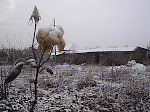
It began early morning winter, let up mid day, but settled in a night’s sky. Its chill has been felt in the thin air since. A week ago the season veered torrential. Little ones watched the world blowing this way and that from their window. Tired neighbors huddled by fires, and those without heat tucked under heavy woolen blankets. Big shops closed. Cars wouldn’t start.
I awoke to the turn. In my home, what came with the white wonders of winter was no gas, no electricity, no water, and a dying cell phone.
As the beep on my Siemans screamed its final seconds, I texted my go-to in times like this: “I’m coming.”
Yes, that’s a great idea! Go! You should get out while you still can! yelled my neighbors I slushed in the fresh white to the bus stop.
But in the big city three hours north of my town, the weather was far worse. The froth in the air was a call to far-north China Volunteers. My tiny toes were frost bitten with the bus ride, and outside snow had dried to ice, which stuck hard to the sidewalks.
“Where is the ice skating rink?” I asked Kelsey.
“We’re coming to it,” she replied, as we followed the dense, uneven ice across the train tracks.
Into the braze of the bazaar, Kelsey, whose enthusiasm for Iowa could win her some sort of award, began, “In Iowa, we call this black ice.” I nodded, assuring that only in Iowa they call it such. “You can slip and fall on this. See,” she pointed to the circular puddle with chunks of frozen molt, “black ice.”
Our limbs tripped to the ground as Kels reasoned, “Why don’t they put salt on this?” I hadn’t thought of this. They do that in the Sierras, up 50, I think.
Endlessly brainstorming best practices for development, we agreed salt shakers and the two of us would best accomplish this job.
Above our heads icicles held tight to ends of towels. After women use bare hands to wash linen, they hang the linen on lines connected to old, rusted polls which cause them to freeze and melt onto heads.
These are things I didn’t know about snow. I didn’t grow up in cold climate, so momentarily powder is Godsend; it is witnessing perfection in a chilled instant. It covers trash, feeds plants, and creates fresh water droplets for the little spotted birds that nest above my balcony. It selflessly delivers so much to the earth.
But Eric once told me that in Maine citizens wake to frozen car engines. Sometimes it gets so cold one has to rush to his destination in 30 seconds or less to avoid frost bite and losing a limb. What the fuck?
There is one grave difference between Maine and Azerbaijan: In America there is central heating, and here there is a small gas petch, like the ones cowboys in Western films to warm their hands by after a long ride in from town.
Most of this country, including the capital, is not set up for the condition it’s in. Pipes freeze because they are not wrapped or secured underground. When roads aren’t paved, days after snow, the melt-off freezes, while offside mud becomes fixed to the bottom of my boots.
Nearing the tarped green bazaar, I explained to Kelsey that this is what Sacramento would be like if it snowed. America would have to come a long way for that to happen, she assured me, as she pointed to the skating rink which is the road to the bazaar.

3/14
My Computer is Working at the Moment. That is a title and a statement.
It might be the electricity. Since Referendum Day and Novruz, the most celebrated holiday in Azerbaijan, are forthcoming, the power has been on most of the time.
Perhaps Allah heard my counterpart’s prayers. “I prayed that your computer would work so I can have your music.” Or maybe I have been plugging something in upside down, or have had the computer positioned at an odd angle, a display of my eternal inadequacy of operating Western technology. All likely stories, where water flows and oil shoots from the ground, yet operate with as much certainty as my mind.


“Sasha Teacher, is ‘set’ a word?” “Yes, Salam, but what does it mean?” “Pen?” “No.” “Table.” “Uh-uh.” “Ummm. Cup?” he points to the miniature coffee mug set on the table next to the pen. “No Salam.”
Simple games like Scrabble, Hang Man and versions of Pictionary are surprisingly popular with these little folk.
The dialogue-centered conversation club switched to an English games club when I noticed students like Salam taking more water breaks than wanting to participate in Q and A round-robin exercises.
Scrabble is now part of my weekly routine. To simplify the game (No, I have nixed rules like you can’t attach words to the tail end of another, while I’ve added others such as you must know the translation of a word to play it.
In the end, the board looks more like Boggle than Scrabble:


I am not a game person. I’d rather cuddle with a book or watch a B-list film than run a monotonous board for hours on end. Unfortunately, for both her and me, the Volunteer closest in distance to my town is a board game fanatic. But playing with fifth graders whose English is limited to five-letter words and simple sentences has made me understand the value of games I once felt redundant. I should reconsider Settlers of Catan with Jenni on a southern night.
“Sasha Teacher, is, ‘zap’ a word?” What an excellent word!, one that can’t be dismissed because of silly teacher-rules. “Fourteen points, Salaam.”

3/16
Plans with a capital P
People are beginning to talk. About leaving. Peace Corps has posted the Close of Service date. This is where we travel to Baku for paperwork and lectures on ‘post-Peace Corps life." See, the problem is that this was such a goal since the day I heard of such a romantic, hard-core experience, that I haven’t really gotten around to thinking about what could happen next. I mean, I have, like I could get a master’s I suppose, or try to find a job at the hopeful end of our economic delirium (that’s what it is, right?). I guess those are plans. But they’re not Plans. A Plan. I should have some sort of Plan.
Most of the people I know don’t have a Plan, though I have always been this kind of girl, a girl with a Plan. Well into the tail end of my junior year of high school I didn’t know I could go to college at all, little lone receive good enough grades to carry me to where I am now (however much living in the middle of a banana republic no one has heard of is worth). But I always knew I would not be where I once was, and that was the Plan. Ok, so now that I’m out, where am I going?
I want to work. I want to be doing something, like I’m doing here, and which, school, even through a master’s program, doesn’t leave room for. There’s a lotta time in a college day, but not the kind that universities are willing to expend. Head in book. Research. Write paper. Repeat process. But then, I miss this. Why do I miss this? I want good talk, good reads and good discussion ya can't get in the work place, I s'pose.
Chicago Schools Service-learning Program looks inspiring. There’s the doing in education. But do I have to go to back to school to work in schools there? A credential with a master’s? More school. One sister wants me in Portland, temporarily a city too small for my ultra-, super-city radar. Add millions of people to the scene and get New York. From village, Azerbaijan to the Big Apple, perhaps a bit of a culture shock. New Orleans was suggested by a friend the other day. Or Philadelphia, where Peace Corps orientation was held—they had a pretty kickin’ night scene. Seattle. Too rainy. L.A.= shit. Detroit. Dirty and down-trodden, I hear. Dallas. Hot. Also hot: Sacramento. Hasn’t even occurred to me to go back there.
And ahhhh, San Francisco. So many friends have left San Francisco and the places I frequented, and really that’s from where my love of the place resonates. Also, it seems a stepping-stone city, the way a bachelor’s is a stepping stone to a master’s. I should go to a bigger city, with more people, and more potential! But why? So much energy, the kind that expires after five in the afternoon tailing to and from the places of doing. This is a very exhausting exercise. Maybe I want to chill in a village in America for a couple years. Do we have those?
Well, I suppose this reads more like a journal entry than a blog. Or does it? I should read blogs. Add that to my of Post-PC To-Do List.
Ok, so here’s the Plan, me, readers: I am going to come back in approximately five months and find a job. Or something. Maybe go back to school. Somewhere. Sounds about as reasonable as living in Azerbaijan.

4/1
Hasan Baba was a cool cat. He dressed himself in a pale blue brimmed golfer’s hat and dark flip shade glasses. Every day he sat on a rock to collect thoughts and say salaams to passerbys. Sometimes his buddies, who were quaint and cool like him, would gather around the rock to read verse from the Koran. They too would wave hi to passerbys and greet newcomers like me with great sincerity. More often than not, though, this is where you could find Baba, pressing his cane to the earth and puffing a cigarette whose smoke drifted to the Kur, just beyond the old bath house and gray, dilapidated levee. Forty meters west of this rock is where Hasan Baba grew up, and where, in his sleep, on March 31, Hasan Baba passed away.
Grandpa Hasan was the first local I met in my village. He was far more thrilled to meet me than I him. “Who is this?!” he laughed, clapping his hands and stomping his eternally white sneakers. He looked around to see if anyone else was seeing what he was seeing: a blond-haired, blue-eyed American girl fresh from California, something in all his years he had only recently viewed with clarity via E! on satellite television. “What is she doing here?!” he would laugh.
Gizbast Teacher, my counterpart and his loving daughter-in-law, has prepared the mourning ceremony. I’m not sure what it’s called here, though I suppose it would be the equivalent of a wake.
There are two rooms: the men’s is under a blue tarp outside, and the women’s in one of Hasan Baba’s bedrooms. “Go sit, Sasha. There they cry,” instructs Farida. She points to the women’s room where, poised on a traditional burgundy carpet, the female mullah sings hymns, praises Baba and begs God to receive his body well.
Women are pleased to see me and whisper smiles when I enter the room. They chant, urge me to join, and we lightly slap thighs in unison. This strikes a deep air of sadness and laughter, much like Hasan Baba himself.
“Hasan Baba can’t hear very well,” his son Abdullah would say. “You have to speak loud for him. Dad! Dad! Do you want more bosboscht?!”
“Would you quiet down?! I’m not deaf! And no, I don’t want more tea!”
Gizbast Teacher would explain to Baba why I have come to Azerbaijan and his village in particular, and either for his veiled disinterest or his hard of hearing, Baba’s small eyes would drift to the ceiling and slowly back to his bi-weekly Turkish serial. “Ok! Thank you for being here!” he would laugh.
Hundreds of people have come to mourn already. Some stay to help with cooking, others for only the prayer ceremony. Most everyone in the community, and family from distant cities, will come to weep for Baba.
After the long, deep prayer we eat a meal prepared by Gizbast, the daughter. The women ask about my being there, in the room, and in their village so far away from my own family where this very event could happen too. They ask me for more tea, which I now consider a gesture of treating me as their own, rather than a servant girl I once thought I was. I serve them and we speak for another hour before I excuse myself to a tutoring lesson at four.
I would like to think Hasan Baba and I shared a special bond. When Gizbast Teacher would complain that Baba spends too much time alone, I would defend him, reminding Gizbast that he is old and has spent many years with family and friends, and needs time to reflect. We would laugh at the way his family would yell in his ear, and turn up the T.V. full blast just for him. He would try to tell me about the Soviet Union, not because he wanted to reflect, but because I was an inquisitive youth, and he was a teacher.
Hasan Baba was 88 years old. In Azerbaijani terms, that’s like 130. People just don’t live that long. 55. 60. 65, that’s a good run. Eighty-eight years old. “He’s a hero to our people,” says my co-teacher Nushaba.
For all I know, Hasan Baba could have been a hero. He lived through the rise and fall an empire, and everything that came and went with it: jobs and job security, falling infrastructure, and dissenters’ imprisonments and deaths, many of whom were his friends.
For the spirit to safely reach God, it must be laid to rest as soon as possible. Within 12 hours, Hasan Baba is carried with 15 men to our village cemetery. They march the dirt path while women weep and wave handkerchiefs from Hasan Baba’s balcony. Now, along with the grieving indoors, loved ones can lay flowers on his grave.
Every Thursday for the next week friends will come to Hasan Baba’s to say a prayer. They will visit Baba’s family on Novruz, for Ramazan, and again, one year after his death day.
In Islam the mourning period is seven days, though because it’s not affordable for Gizbast’s family, this one will be only four. “We wanted Baba to see wedding. Mine and Jeyhun,” says Farida, who on Sunday had set her wedding celebration for April 25. She and her brother, both who will marry soon, must postpone their weddings for 40 days after Hasan’s death. This is the amount of days it takes a family to cry, says Farida.
Funerals in America are distant and brief, like too many of the relationships we hold. The
clapping, the chants, the crying and laughing, confined to a room in a moment of remembrance. On Hasan Baba’s death day, and on my birthday, I have been able to grieve.

Monday, December 22, 2008

Highlights of a day's work:

“Sasha, I am sorry I am late for class, I was arguing with Hamana Muellim (Teacher) over grammar.” It’s how they release sexual tension, arguing grammar rules. “Read this: I work the most of all. Would you say this?” “Sure. What’s wrong with it?” She’s dying to tell me. “You do not use the here. It should be ‘I work most of all.’” “Why? I would say,” and I write, “Of all the students, she is the best singer.” “No, it is not the same! ‘Best’ is an adjective here.” “Yeah, it doesn’t matter—” “It does matter! But Hamana said that words there are some verbs that act as nouns, and are treated as nouns in this sentence.” “Well, yeah, but—” “I don't really understand what she is saying. I have not learned this. If it is true, I must tell all my students about this adverb.” “I don’t know, it’s what we say—” “You would say, ‘She sang worst of all the students.’” “No, I would say, ‘Of all the students, she sang the worst.’” She literally threw the pen on the desk. I will hear about this tomorrow, in a “See, I told you” kind of way.

“Sasha, come to my house to teach me computer,” so I did, and she was like, “I want to know about English grammar. Are there grammar games on here?” “No, I don’t have any grammar games, but you can get them from the internet.” “Ok.” “Ok. Do you have internet?” “No, but you do. You have computer.” “Yeah, but there’s no internet in the computer. Do you have a telephone line?” “No.” “Then you can’t have internet.” “But you have computer.”

“Sasha, light the petch. Don’t be scared.” “I’m scared, Yusif.” It’s a fucking torch. “I will light it, don’t turn it off.” “What if I have to leave?” “Keep it on.” “When I go to bed?” “Keep it on. Tomorrow, what time do you come home from school?” “Twelve o’clock.” “Keep it on…If you need to turn it off, turn it off here, here and here, or it will explode, Kapppewww!”

Wednesday, December 17, 2008

1. The temperature in my apartment has been dropping a degree for four consecutive days. The gauge currently reads 6 degrees Celsius. If it continues at this rate, I should awake to a white Christmas on my face.

2. Kelsey on how to check if I turned off the stove: “Put your detector next to it, if it doesn’t beep then gas isn’t leaking, or your detector is broken.”

3. “Eat! Eat!”
“I’m full! I can’t!” I’d shouted back.
“Sasha, eat!”
The puke is coming, I know it. I can’t tear off fat from the goose meat, or sip more oil-salt based soup.
“Eat bread, Sasha!”
Now putting the spoon down. Host mother will be offended.
“I can’t, Sevda!”
“Sasha, eat!”
“I’m full!”
“Do you want tea?”
If I have tea I have to have cookies. But if I say no, she’ll be offended.
“No, I don’t want any.”
“No?! But you must! Drink tea!”
“I can’t!”
“Just one cup, Sasha.”
I felt like a toddler, crying when I wanted food, screaming when I didn’t. Explaining I have to wear leggings to school to cover my tattoo, defending why I have one in the first place. Insisting I can walk to school on my own, and travel to Baku on the bus, even with the language barrier. Trying to communicate I want to be alone, when in reality I never will be, not Azerbaijan.
In the first weeks with my training host family I couldn’t convey my displeasure for bosbocht again, or my discomfort with blaring midnight mugam music for the fifth night in a row. So I’d shut myself inside my room, inside my sleeping bag, with a headlamp and a book that would take me back to green, warm valley.
When we’re sad, this is what a lot of us Americans do: take a time out, and maybe cry alone, internalizing pain but reflecting on it to forge ahead.
When Azerbaijanis are sad, however, they huddle together and talk.
We open the window for fresh air and color, and they keep the drapes shut from their neighbors (or the KGB).
We believe in medicine, they in the rituals of the Persian Empire.
Americans eat the meat part, and Azerbaijanis the fat.
We write story, while they retell it.
Muddy flip-flops, spotless boots.
Blue jeans, black slacks.
One hour, one week.
Coffee, tea.
Cold, hot.
Ask, tell.
“Sasha, drink tea, and then we will eat. Here is an apple and persimmons and a banana. First eat this.”
At the dinner table last night Nativan filled the deep bowl with bosbocht, and passed it to my placemat with several pieces of Baku bread.
“Sasha, eat!”
I ate the loaded bowl, pulling out seeds from alcha, cherry pits used as a bitter sweetener in this soup.
“Sasha, give me your bowl. You must eat more.”
“No, Nativan, I’m full.” Three small children loitered, spooning imaginary soup into toothless mouths. “Eat, Sasha! Eat!” they mimicked their mother.
“Sasha, you are our guest, eat!”
“I know I’m you’re guest, Nativan, but I am full. I am finished.”
“Eat bread, Sasha!”
“Nativan, I will eat however much I want. I can’t eat any more. I am finished.”
“Why, Sasha? Eat!”
“Because I am full, Nativan. I will not eat more. In America this is not nice. You cannot tell me to eat more. I eat will what I want.”
“But Azerbaijanis like to feed their guests! You are a guest, Sasha, you must eat!”
Americans are taught that we can do and feel what we want, when we want, and express our opinions on any platform, indefinitely.
Azerbaijanis are not taught this. It is why they are astounded when I simply say, “No, I will not eat any more.”
Americans are raised to know what is best for the self, and to let others discover what is best for them.
Azerbaijanis are taught that the group matters. They are told guests should be given more than anyone at the table, even if the guest says she is full.
Host country nationals do not experience the awkward, scary, fragmented, liberating growth that PCVs do. Even if they did, they’d probably end on the same side they started, just as I have, but with more graceful ways to communicate it.

4. Cooked pad thai using ketchup yesterday. Don’t do that.

5. My counterpart’s daughter is more in tune with American culture than I ever have been. Like most Americans, Azerbaijanis live on credit, and here, they have satellite television to show for it. I had heard from PCVs that Brittany is back, and last night I saw her new pop video, which I swear is the same one that’s been airing for the past decade. “Madonna is helping her,” winked Altunay. The secrets of Hollywood, disclosed by a 14-year-old living in Azerbaijan.
Altunay was also the first to inform me news of the Iraqi journalist. She reported, “Man throw shoe at Bush.” After googling it, I realized there was no need to decode that one.

Monday, November 24, 2008

My new sitemate, Jordan! Yay, Tekhas!

Sunday, November 16, 2008


Iowa Monster Cookies

Well this is just about the damned best hunk of sugar you’ll ever eat. From Charles City to Azerbaijan and right back at'cha. Courtesy of my friend, Kelsey.

“We’re not really what you would call foodies in Iowa.” -Kelsey, while eating marshmallow fluff straight from the jar.

6 eggs
2 c. white sugar
1/2 tbsp. syrup
1 c. margarine
1/2 c. chocolate chips
3 c. peanut butter
2 c. brown sugar
1/2 tbsp. vanilla
1 1/4 tbsp. soda
9 c. oatmeal
½ lb. M&M’s

Mix in order. Be sure to mix in soda well. Drop by spoonfuls onto cookie sheets and flatten slightly. Bake 12-15 mins. at 350 degrees. Yields two dozen, at least, but eat no more than two unless feeling pukey is your thing.
11/16
Post from Oroville to Azerbaijan

“SASHA!!!NOOOOOOOOOOOOOOOOOOOO! I know your a san francisco libral...but come on. this guy is going to kill us . . . if this article is how you feel about our country than maybe you should stay out of it, sorry but im tired of usa haters, especially bill mayher.”
This is an excerpt, all the slander about Obama left out because that much was expected. What’s included is what was not expected, and what’s kept me in near-tears for two weeks.
This letter was in response to an Onion article I sent a friend after she lambasted Obama’s win with multiple MySpace bulletins. “the only good thing about this is that racism is now over! there is no more white guilt, black people are not special anymore, they are just a regular ass hole like the rest of us.”
The headline was something like, “America Finally Shitty Enough to Vote for Social Progress.” I intended for it to piss her off a little, reasonably charm the anger out of her, and knock some sense into her conservative pea-brain noggin. “We’re family,” I thought. “She’ll find this funny.” That was so not true.
“how much do you think my mom should be fined or how long she should spend in jail for not getting health care for the kids, or taking obama’s mandatory health care because she feels it’s none of there god damn business what she does as far as thats conserned? do you think my mom is a bad mom? . . . i cant believe your an elitest with the family you got and growing up with me and my family. . .”
As a kid, her mom would tell me that I’d grow up, become a successful business woman, and forget about her family. “Of course I won’t,” I’d respond. “How could I forget you?”
They now live in Oroville, a four-hour, smoke-swathed drive up the five, just past Chico. After I transferred to SF State I had school, past-midnight work shifts, tutoring, and loads and loads essays. I focused on adapting to San Francisco’s neon bicycle hats, brunch with the girls, and freezing f’ing bondfires.
Carla was right, I grew up, moved on, and found a life I could live with. I visited them once, maybe twice a year. I didn’t see them before I left for Peace Corps.
“I cant wait to see what kind of change we are going to have, lol. mabe becoming sweeden, right?. . . sasha, i thought you were smarter than this, your a college graduate from a university!!!!! i cant even talk about this anymore, im supposed to be celebrating tonight because i just got hired today at radio shack.”
I want to tell to her she’s never been to Sweden.
I’d like to share that I am here to serve our country, not in the way that our Army friends do, but in a more peaceful, cooperative way, as naïve as that may seem.
She needs to know that before I left I was skeptical of the U.S. government and people’s complacency to blindly follow suit. But after having lived in Azerbaijan, I am ever more grateful to be an American citizen. I can’t wait to go back to teach, and learn more about my country.
I want to scream, You can’t reform California schools from a second-rate electronics shop!
I won’t tell her these things, though, because after reading her response, I felt like I often did growing up, when her mom would tell me I’d run away and never look back.
They just don’t understand.
“we are living here in america right now, feeling this pain, your not.”
She’s right, I am in my 45 degree apartment (it’s not winter yet!!), and I wonder if it’s all worth it. Not the Peace Corps, although this experience is part of it.
It’s all so f’king hard sometimes.
I could go back. I could rent an apartment in Carmichael with high school friends and attend Sac State to work as an English teacher. I could. I really could.
But I want resources for students that I didn’t have. I want support for local schools, teachers and students. I’d like to see real commitment from real committed people. In SF and here, they are the people I work with, whether or not they are “elitists.”
“i voted for john mccain because he represented me and my family, most people voted for obama because he was black..and i dont think thats any better than voting against him because he is black. your supposed to judge them by there character and conduct . . . ”
I voted for Obama not because he is black, but because he is empathetic. Obama is up for program reform, in health care and education, and in an economic system whose problems have been ignored for 200 years too long.
Mostly, Obama assures me that my day to day is right and good, and that’s a long haul from the posts of Oroville, California.

Tuesday, November 11, 2008

11/11/08

Yesterday I made a caterpillar alphabet. On the head I attached pipe cleaners for antennas and googly eyes, courtesy Mom. The patterned green, blue, red, orange and yellow slinks up and down the wall of my fifth form classroom, as a caterpillar would.
It’s the most eye-popping visual aid they've ever seen. “What is this?!” “Woah!” So bright, so funny, so new and weird.
Jenni told a friend that her work as a Youth Development Volunteer is terrible and amazing. Terrible because everything she does is grass roots and has never been done, and amazing because everything she does is grass roots and has never been done.
Same goes for teaching.
The walls are bone bare mostly, with three hand-drawn and painted posters hung where few eyes drift. John Galsworthy and Charlotte Bronte depict modern English literature. Some written in Russian to English instead of Azeri, paint peals off the visual aids from decades of blistering sun and zero restoration.
This school year is infinitely more enjoyable than last. Teachers have adjusted to me, and I to them. They understand what I expect, and what I have had to compromise. They know that I can make up lessons on the spot, but prefer pre-written plans to follow.
I understand their customs, mostly that children and home trump work. They can plan at school but not at home where they have to cook and clean and prepare winter jam. I know that I have to tell the director what we’re doing and when we’re doing it. I know more of what they want and need, and they tell me when I don’t.
This year one of my goals is to provide a more creative environment in which to learn. Both teachers are pitching in and are totally excited. I am restoring old visual aids, swapping Dickens for Vonnegut and Hemingway, and drawing quarky vocab flashcards to make students laugh.
All this takes this takes paper and markers, I tell Nushaba. And a little imagination. We’re working on that.

Monday, November 10, 2008

11/10/08

Excerpt from 6th grade text book

3. Listen to the dialogues and and pay close attention to the intonation.
3a. Now listen again and repeat.
3b. Translate the dialogues. Use your glossary.

I. Emil and Araz are talking
-It isn’t easy to make friends,Araz.
-It is not for me. I’m a good mixer.
-Really? Do you have many friends?
-Yes. Some are my schoolmates and visitors to our country. They live here with their parents.
-How did you get to know them?
-I met them at parties, at the stadium, during summer camps and in our playground.
-Are they all foreigners?
-No. Some of them are.
-What languages do you speak with them?
-Azeri, English and Russian.
-Oh, you know many languages.
-Not so many. But I’m going to learn French.
-That’s great.

How many languages do you know?
Are you a good mixer?


“Are you a good mixer, Gizbast?”
“No,” she pauses, considers her potential. “No, I don’t think. Sasha, are you a good mixer?”
“I don’t really know what a mixer is, Gizbast.”
“I think it is to have some friends, to approach people well.”
“No, I don’t think so.”
“Also, a singer is mixer.”
“Oh, a DJ!”
“Yes, I have seen on television.”
“Yeah, MTV Turkey. Many good mixers there.”
“Yes, they are mixing well.”

Saturday, October 25, 2008

8/3

“Salam, Mahir.”
“Salam, Sasha! Netirsuz?”
“Yakshiyem, sag ol. Yumurta lazamdir, sonra bir kilo pomidor ve yaram kilo badamjan.”
“Sasha, ders yakshidir?”
“Ha, bu il yakshidir. Gelen heft meshkala olajac. Hem de gargadala—“
“Hi, can I ask you a question?”
“What? Yes, what? Wasn’t expecting that. You speak English.” Pinstriped, fitted gray slacks and a mere gold tooth, he is a Baku man.
“Your Azerbaijani is very good. Have you been here for long?”
“Oh, thank you. A year. And I’ll be here for another year. But my Azerbaijani is not very good.”
“But they understand you, and you understand them. It’s good! And what are you doing here?”
“Teaching English.”
“In Baku?”
“No, here.” I point up the short road leading to the medium-sized secondary school where I teach.
“Oh. Why?”
Routinely, I explain that I’m an American Peace Corps Volunteer, that I’m here to serve two years, and that there are tens of us, scattered across this tiny country to help Azerbaijan develop. He nods, with a look of neutrality.
“I haven’t seen you before. You live here?”
“Yes, I live here. I have no reason to speak with you. My brother and sister also speak English but they are also old, have children. They don’t need to speak with you.”
Sabir works for BP Offshore in the Caspian. He is engaged and travels to our community twice a month to visit his family. He was less excited to see me than I him.
“Yes, I understand. I’m just surprised—“
“Why are you surprised?”
“Because there are few people here who speak English. Just the English teachers, and my host sister.”
“No, no, there are many people who speak English, you just don’t know them. They don’t need to speak to you.”
I guess they don’t. Damn, I’m not as famous as I thought I was.
Turning his head as he walks out the door he adds, “It is very strange that you live here.”
“Yes, I know.”

10/22
This blog leads me to
A typical marshrukta conversation, two hours after I have stared at Azerbaijan from my window while ladies in paisley headscarves have observed me like growing fungus.
“Excuse me, where are you from?”
“California.”
“Oooooh, Califoniya. Arnold Schwarzenegger, president.”
“No, governor.”
“Oh yes, governor. Where are you going?”
I fill in the messenger, as women, children, gross boys and the driver clamor behind seats, waiting for the reply.
“Are you Russian?” She asks in Russian.
“No, I’m American, I speak English and a little Azerbaijani.”
“You don’t speak Russian.” Bemusing.
“She doesn’t speak Russian,” she passes up the line of passengers.
“Where do you live?”
Same place, I say.
“You live alone?”
“Yes, I live alone.” It was more difficult when I lived with an Azerbaijani family, as Volunteer, little lone Host Family, is way weird of a concept.
“Your family lives here too?”
“No, they live in California.”
“Do you have a husband?”
“No, I live alone. Just me.”
“Children?”
“No, I live alone. Just me.”
It’s shock value, like skydiving, but they’ve never even heard of skydiving, so this bus ride is a waking revelation.
“Where do you work?”
“I’m an English teacher.”
“Oh, you must make lots of money. How much do you make?”
“About 250 manat a month. I am a volunteer.”
“No, no. 250 manat? That’s a little bit of money. You are American. You have money in America?”
“No. I am a volunteer. It’s just to live, to eat, to travel. It’s just me. I don’t need a lot.”
“It’s still a little.”
“Yes, ok.”
“You must be a guest!” At their house, they mean. “Gonag ol!” “Be a guest!” they say, and I can’t get the 10-foot dancing teapot out of my head.
“Yes, I will try.” If I took up every guesting invitation offered, I’d spend all of what little I make on marshrukta rides to the towncenter. Fortunately old Soviet types haven’t adjusted to the cell phone culture so no whipping out numbers. Only a young nuisance asks on occasion, and I bat him away, fortunate to live in a country where that is expected.
We pull to my stop on the dusty bed and they shout, “You are a beautiful girl! Come visit us!”
Nowadays it’s common that someone has met me, or their cousin or uncle has met me, so they transcribe to the bus my story, while I continue to stare out the cracked window to the oil rigs and dry cow pastures ahead.

Thursday, September 18, 2008

7/17/08
I’m plopped underneath what my landlord calls an air conditioner, though I’m not sure what the hell it’s emitting. Air? Maybe. Cool air? Possibly. Grime particles from months—years, possibly—of disuse? Definitely.
The weather here has been unusual. It’s rained off and on, been cloudy and overcast on occasion, and sometimes it’s so hot, sprawled half-naked on my bed, I sweat tears onto literature.
The other day Gizbast laughed, “They say the English girl brought climate from California.” In Sacramento it’s often hotter than this, I’ve since notified neighbors, though in most parts of America there’s escape: air conditioned movie theatres with iced Coca-Cola. In my village, the government shuts off the power at approximately 10 a.m. to 1 p.m., 3 p.m. to 7 p.m. and midnight to 6 a.m., never permitting my freezer time to do its job. Consequently, I drink luke-cold liquid on a 100-degree day.
But there’s a silver lining to this cloudless heat.
Author Hosseini writes about how prior to Soviet arrival Afghanistan was a land of milk and honey, fruits and nuts, men who drank tea on white patios and children who flew hand-made kites, even when it snowed.
Many may be under the impression that Azerbaijan is a vast desert, a stretch of oil machinery between partially green mountains and unpaved roads. There are parts of this country that are like that, though much of the Middle East and then some (whatever you call this part of the world) holds enough vegetation to be split with many African nations.
Purple, yellow, green and red plums, at least that many breeds of cherries, small and large apricots, white figs, tiny strawberries, winter and summer apples, round watermelon, mulberries and blackberries the size of my thumb, pomegranates, and green grapes drape almost every Azerbaijani family’s front yard. These are the crops that make this harsh land gentler.
To save some of this fruit from Azerbaijan’s annual waste, Azeris make jam and “murraba,” a more liquidy and sweeter take (1 cup: 1 cup) of jarred fruit. Since June I have made six large jars of applesauce and cider for winter, and received numerous jars of jam from neighbors and volunteers.
Even so, I can’t eat the fruit or make jam of it before it rots. There is so much juicy vegetation in summer I have had to throw most of what my neighbors give me to the sheep.
At the end of this month I am on leave in Latvia, Lithuania and Poland. The plan was to beat the blazing sun, at its most intense in August. Unfortunately vacationing at this time means I’m missing prime sweet crop life in Azerbaijan. Hopefully they’ll jar me up a few containers of their all-natural jam.

9/7/08
I hope there’s never a tea famine

Three days ago the gas line to my apartments and surrounding houses exploded. As many families do, I don’t have a petch, an extra heating device in case an event like this goes down, or better, the government shuts off the line (like it does in winter when lowly citizens ask for warmth.)
My source of hope would have been the electric stove my landlord snabbed a couple weeks ago. But while I was drinking forbidden beer in Europe he was locking wash buckets, tables and kitchen utensils in the closet adjacent to my vanity mirror.
This apartment came furnished. Trying to be helpful, I think he was clearing out unused furniture and appliances to make room. Unfortunately, I use most of those appliances, the alternative stove among them. I beat the crumbling kitchen wall, yelling profanities about Yusif for taking part of my life away. My neighbor, clipping her husband’s white undershirts to the line, overheard and poked her head onto my porch, “Sasha, I know you are angry. There will be gas soon so we can drink tea.”
Tea is a tremendously important part of this culture. Each tiny cup is served with sugar cubes cut from a heavy block of white sugar and cream-filled Russian chocolates that feel like plastic on the roof of your mouth. After dinner, before dinner, while watching TV, or judging neighbors from their balcony, you can find a native slurping near-boiling teze (fresh) tea. Outside of chai khanas (tea houses) in 120 degree temps, Azerbaijanis play nard over tiny glasses filled with ginger-colored liquid. It is a cure for just about everything, from a headache (which couldn’t come from too much caffeine…) to an ear infection.
So the fact that I can’t eat isn’t my neighbor’s concern but rather the fact that I can’t brew Beta black. “What will you do?” I don’t know, I just don’t know.

9/12/08 ONE YEAR TILL FLIGHT TO SFO

9/17
The Patriotic Act

Fresh from vacationing in the Baltics, I slip off my shoes and into oversized slippers. To watch my toes before they trip on the dip after the welcome mat, I flip on the light switch in the musty hallway. No electricity. Throwing off my backpack, less heavy than it was when I left (I lose so many things travelling), I shuffle to the kitchen to cut veges for eggplant and chicken curry. No gas. Though I have adjusted to this diverse lifestyle (sometimes ya have water, sometimes ya don’t!), after a month backpacking Eastern Europe, it is a realization of the 360 more days I must stay in desolate Azerbaijan.
At PC’s mid-service conference for 2008 Volunteers, an American observer for Azerbaijan spoke about elections in October. Five years ago Ilham Aliyev, the current president, took his father’s seat in parliament. Before he took office, there were protests, riots and violence which led to the arrests of several dissenters. Despite public opposition, Ilham was elected by a landslide.
This year Ilham will be reelected. The election observer noted that there will be few protests (more like gatherings of a couple people) and the dissent, if any, will happen indoors. This is because one, Ilham is already president, and he has repaved highways and built schools and such, and two, opposition parties and their candidates aren’t visible in mainstream media. The latter is because of a new law that allows little airtime for candidates to spread their policy views. They say this is to give candidates equal opportunity.
Here’s the thing, I don’t feel moved by this, in large part because American politics needs campaign finance reform too. Like in Azerbaijan, parties and candidates with money have more airtime and media coverage than those without. From George Bush, we hopped almost straight over to his son, Stupid, notwithstanding protests on the legitimacy of his win. And under Stupid, in spite of critical failure in every possible policy sector, roads were repaved and schools were built and such, and so he was voted on for a second term.
Perhaps surprisingly, there are several small parties running for office and of those, nine are boycotting the election. “Why boycott? Why leave a better chance for Ilham to be reelected?” asked one Volunteer. First, because the boycotters know Ilham will win no matter what. Even if another candidate could rise before the election, Ilham has gained the support of the population. Mainly, though, the boycott is an international appeal. Those refusing to participate, demand justice. They want a guarantee of what every infant and aged democracy strives for: a free and fair election.
But my problem is not even this. It’s great that candidates are appealing to the international community, and that the citizens of Azerbaijan want to vote for their current president. What bothers me is that under these conditions, as a Peace Corps Volunteer, I can’t encourage people to vote or to side with the little guys. I have to remain silent, not allowing my opinion to filter into classrooms or even into private homes. We are to stay away from political gatherings and discussions on any level.
Peace Corps is a non-political development organization. To speak poorly of host country politicians is olmaz (forbidden). It could put Peace Corps, its staff and Volunteers at risk. One could lose credibility for dissent or become at odds with their community if they side with an unpopular candidate. For my family’s sake, I don’t want to mention what could happen to a Volunteer in a violent political environment.
That is not to say we can’t talk American politics. I can and do with host country nationals. Our conversations usual involve the idiocy of G.W., how I disagree with so many of his domestic and foreign policy decisions, and how his administration single handedly pulled the U.S.’s GDP from a roughly two trillion dollar surplus to a deficit equaling that, at least. They usually laugh at this until someone asks, “How can you say that about your president?”
But when I say things like this, and things like, “American politics needs campaign finance reform,” I know there’s a difference between America’s campaign finance problem and all 47 African countries’.
I don’t know if you’ve noticed but every blog I write ends on a positive note. It’s not the best thing to do with narrative, but here it’s what I have. I am American, and I don’t think in “It’s not possible,” “The government won’t permit it,” but rather, “I can” and “I will change it.” Whenever the electricity shuts, ironically, I feel more empowered to make change in my own country, where I can call George W. Bush stupid. How can I do that? Because the the American government doesn't have the right to turn off the electricity, and the American Constitution secures me the right to make sure they never will.